



![Landbot Pricing 2026: Is It Worth It? [Review + Cost Breakdown]](/images/6a43cb71167b766ca403aff0_6a43cb7084b9f5c287f8d7dc_landbot-hero.webp)
64% of small businesses plan to adopt AI chatbots by the end of 2026, up from 38% in 2024. That demand is what platforms like Landbot are built for: visual, code-free chatbots that small teams can launch without an engineer.
But Landbot's pricing has changed materially in the last 18 months. WhatsApp is now its own dual-tier track. AI chats are billed separately from regular chats. The Starter plan that was $45 is now €40. And the product itself shifted from "chatbot builder" to "AI Agent platform." Below we walk through what Landbot costs in 2026, what's actually new, and where Voiceflow (a multi-channel chat and voice agent platform) fits as a more flexible alternative.
Landbot Pricing 2026
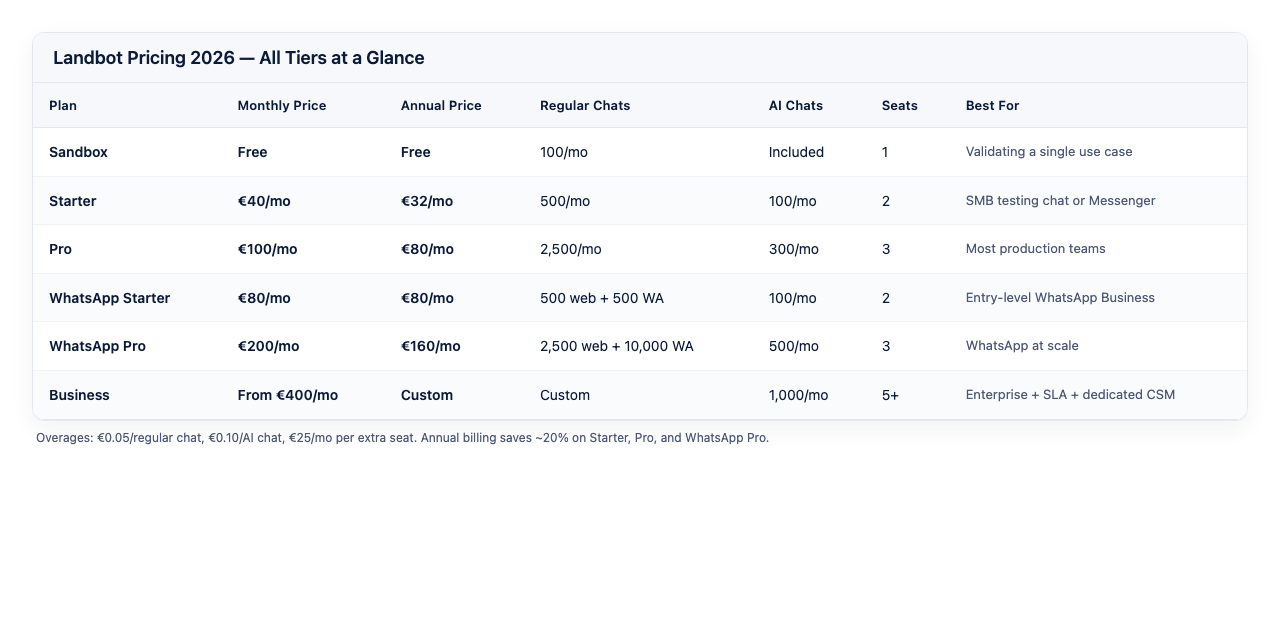
Landbot now publishes pricing in EUR with five paid tiers plus a permanent free Sandbox. The plan structure split apart in 2025 to put WhatsApp in its own dual track, and every tier now includes a separate AI-chat allowance on top of regular chats.
Here's the current breakdown at a glance:
What you actually pay each month
Sandbox (Free): 100 chats per month, 1 seat, basic flow operations. Permanent free tier, not a trial.
Starter: €40/month, or €32/month billed annually (20% off). Includes 500 regular chats, 100 AI chats, and 2 seats. Channels are limited to web and Facebook Messenger.
Pro: €100/month, or €80/month annually. 2,500 regular chats, 300 AI chats, 3 seats. Adds full integration access and removes most Starter limits.
WhatsApp Starter: €80/month. 500 web chats plus 500 WhatsApp chats, 100 AI chats. The cheapest way to get Landbot's WhatsApp Business API integration.
WhatsApp Pro: €200/month, or €160/month annually. 2,500 web chats plus 10,000 WhatsApp messages, 500 AI chats.
Business: From €400/month. Custom chat limits, 1,000 AI chats, 5 seats, dedicated CSM, SLA. Quote-based for higher volumes.
The numbers that aren't in the headline price
Three line items determine whether Landbot fits your actual usage:
- Regular-chat overages: €0.05 per chat above your tier limit.
- AI-chat overages: €0.10 per chat above your tier's AI-chat allowance.
- Extra seats: €25/month per seat beyond your tier's included seats.
Worked example: a small team on the Starter plan (€40/month) hits 1,000 chats total, 300 of them AI. That adds €25 in regular overages (500 chats over limit × €0.05) plus €20 in AI overages (200 AI chats over limit × €0.10). True monthly cost: €85, not €40.
That's the common Landbot price-vs-cost trap. The tier prices are honest, but the AI-chat overage is the line item that catches teams who underestimate how often customers fall through to the LLM-powered AI Agent flows.
Where Voiceflow's pricing comes in
Voiceflow's billing works differently. There's a permanent free Sandbox tier with 1,000 credits per month, then usage-based paid plans where every user message costs 1 credit and phone-call minutes cost 10 credits each. Plan tiers (Starter, Pro, Business, Enterprise) scale the credit pool and editor-seat count, with Viewer and Billing roles free across all plans. Current prices and credit allowances are on voiceflow.com/pricing. The structural difference: Voiceflow doesn't separate "regular chats" from "AI chats" because the AI is the agent, not a feature on top of a flow.
What Is Landbot? (And What's New in 2026)
Landbot started as a visual chatbot builder. In 2024 and 2025 it repositioned around AI, and the homepage now headlines "AI Agent Chatbots." The visual flow editor is still there, but the company has shipped several AI-native features on top of it:
- Landbot AI Agents. GPT-powered conversational agents that combine LLM reasoning with the existing rule-based flow primitives.
- AI Copilot. A builder-side assistant that helps you generate and configure flows from natural-language descriptions.
- AI Smart FAQ. Automated answer generation for frequently-asked questions, pulling from your configured knowledge base.
- AI Appointment Assistant. Lead-to-appointment conversion announced in early 2026 (MarTech Cube coverage).
- GPT-4 integration. Native support for OpenAI's GPT-4 inside Landbot flows.
Landbot's customer service chatbots are used by enterprise customers including Allianz, BNP Paribas, Generali, and Prudential, alongside thousands of SMBs and independent operators. The company has raised approximately $13M across multiple rounds, most recently a 2026 round led by Demium, so it's a stable platform rather than an early-stage bet.
Here are the primary features that still anchor the product:
- Visual flowchart editor. Visual menus let you build conversations as flowcharts, with no code required.
- Channel coverage. Web widget, WhatsApp Business API, and Facebook Messenger natively. Landbot is text-only; there's no native voice or phone channel.
- Code-free integrations. Works with Zapier, Webflow, WordPress, Stripe, Slack, Shopify, and others.
- Knowledge base for AI agents. You can create and curate knowledge bases that your AI flows query for answers.
For the distinction that matters most in 2026, see chatbot vs. conversational AI. Landbot sits closer to the rule-based-flow end of that spectrum than to true conversational AI, even with the new AI Agent layer on top.
Landbot Free Trial
Landbot offers a 14-day free trial on all paid plans, including the WhatsApp tiers. New sign-ups don't need a credit card. After the trial ends, accounts automatically downgrade to the Sandbox (Free) plan rather than getting cut off, which means you can experiment, lose the trial, and still ship something at zero cost.
Sandbox itself never expires. The constraints are real, though: 100 chats per month, 1 seat, limited flow operations, and limited integrations. It's enough to validate a single use case, not enough to run a real business on.
Landbot Integrations 2026
Landbot's native integration list is built around code-free connectors for the most common SMB stack. Here's the current list per landbot.io/integrations:
- Zapier
- Webflow
- WordPress
- Stripe
- Slack
- Shopify
- Calendly
- Segment
- SendGrid
- Dialogflow
- Google Sheets
- Hubspot
- Mailchimp
- Airtable
- Carrd
- n8n
Note that Salesforce is no longer a native integration. Google Analytics also no longer appears on the integrations page. On Pro and Business plans you can connect anything else via custom code and webhooks, but the native list is what most buyers will use day-to-day.
Landbot Alternatives
If Landbot's text-only channels, fixed model choice, or AI-chat overage math don't fit your use case, there are stronger options. Below is a short list of the best AI chatbot builders worth comparing. If you want full code-level control or self-hosting, you might also explore open-source chatbot platforms as a counterpoint to Landbot's closed SaaS model.
Voiceflow: the multi-channel agent alternative
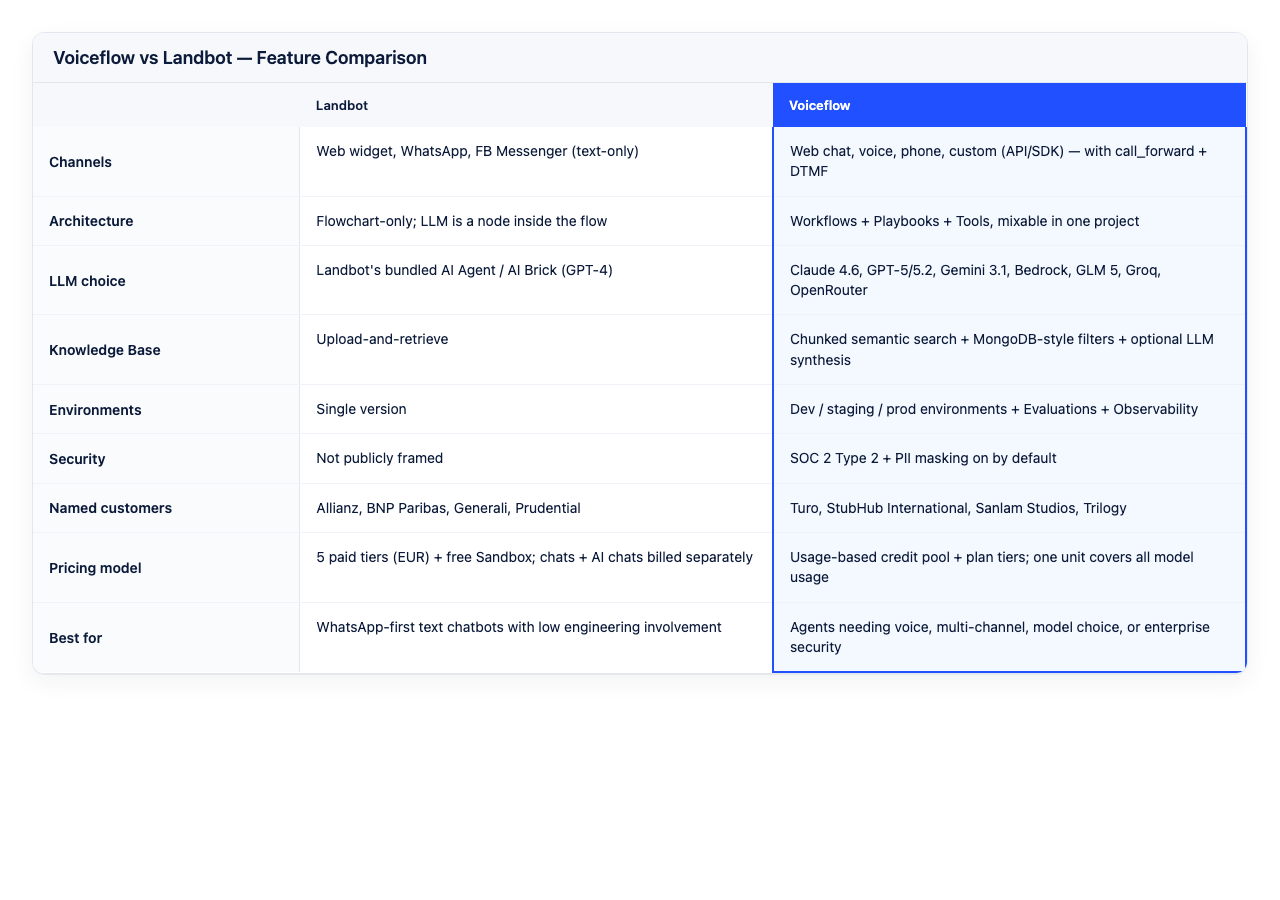
Voiceflow overlaps Landbot's no-code positioning but is built for a different shape of agent. It's the cleanest direct alternative for teams that have outgrown flowchart-only chatbots and need to ship full AI customer service agents. Five concrete differences:
- Voice and phone from day one. Voiceflow runs the same agent across web chat, voice, and phone, with
call_forwardfor live-agent escalation,dtmffor IVR menus and secure PIN capture, barge-in, and multi-provider speech-to-text (Deepgram, Google) and text-to-speech (ElevenLabs, Google, Polly). Landbot has no native voice or phone channel. - Model-agnostic. Voiceflow runs Anthropic Claude 4.6 Sonnet by default, with one-click swap to OpenAI GPT-5/5.2, Google Gemini 3.1 Pro, AWS Bedrock-hosted Claude, Voiceflow-native GLM 5, Groq Llama, or OpenRouter. Landbot's AI Agents run on what Landbot ships.
- Workflows + Playbooks together. Voiceflow agents combine deterministic Workflows (for payment, KYC, anything where the sequence has to be exact), LLM-reasoning Playbooks (for open-ended conversation and dynamic routing), and Tools (Functions, API calls, MCP connections). Landbot is flowchart-only. The LLM is a node inside the flow, not the agent's reasoning layer.
- Production primitives out of the box. Knowledge Base with chunked semantic search over OpenAI embeddings, MongoDB-style filter operators, and optional LLM synthesis. Plus dev/staging/production environments, Evaluations for testing before launch, and Observability for production monitoring.
- Enterprise security. SOC 2 Type 2 compliant with PII masking on by default. Customers include Turo, StubHub International, Sanlam Studios, and Trilogy.
Other Landbot alternatives
- ManyChat: A no-code chatbot platform specializing in Instagram and Facebook Messenger automation. Strong fit if your Landbot use case is social-channel lead capture rather than website widgets.
- Botpress: An open-source conversational AI platform with stronger developer ergonomics than Landbot for teams that want code-level customization.
- Tidio: A customer-service-focused platform with live chat plus chatbot capabilities. Better fit than Landbot if your priority is hybrid human-plus-bot support rather than pure self-service.
- Yellow.ai: An enterprise-focused conversational AI platform with 150+ integrations and 15+ supported LLMs, geared toward CX and EX automation at scale. Pricing is custom and sales-led, making it a poor fit for SMBs comparing against Landbot but relevant for larger evaluations.
- Drift (now part of Salesloft after a Feb 2024 acquisition): A conversational AI chatbot focused on B2B revenue and buyer-journey engagement. Drift Engage, Site Concierge, and Bionic Chatbots are the recent product lines. Less of an apples-to-apples Landbot alternative now that it sits inside the Salesloft revenue suite, but still worth evaluating for sales-led teams.
Larger organizations evaluating beyond the SMB tier often look at dedicated enterprise chatbot platforms where the buying motion, security posture, and integration depth match a procurement-driven sale rather than a self-serve signup.
Landbot Reviews
Landbot's Trustpilot rating sits around 3.7 out of 5 across 100-plus reviews, up from a lower score in earlier years. The themes are mixed.
Positive reviews highlight the speed of standing up a chatbot, the simplicity of the visual editor, and the responsiveness of the customer-support team. The WhatsApp integration gets particular praise from users who picked Landbot specifically for that channel.
Critical reviews cluster around two themes: billing complaints (especially around downgrades and overage line items) and the limits of flowchart-only logic for more complex use cases. Critics argue Landbot's flowchart-based approach falls short of what LLM-powered AI agents can do for genuinely conversational scenarios, even with the new AI Agent layer.
Landbot Pricing FAQ
How much does Landbot cost?
Landbot's paid plans start at €40/month for the Starter tier (€32/month annually), with Pro at €100/month, WhatsApp Starter at €80/month, WhatsApp Pro at €200/month, and Business from €400/month. There's also a permanent free Sandbox tier with 100 chats per month.
Is Landbot free?
Yes, the Sandbox tier is permanently free. It includes 100 chats per month, 1 seat, basic flow operations, and limited integrations. It's a real product tier rather than a trial, but it's not enough capacity to run a real customer-facing chatbot.
How much is WhatsApp on Landbot?
Landbot's WhatsApp chatbot is split into two tiers. WhatsApp Starter is €80/month and includes 500 web chats plus 500 WhatsApp chats. WhatsApp Pro is €200/month (€160/month annually) and includes 2,500 web chats plus 10,000 WhatsApp messages. Both include AI-chat allowances on top.
What's the difference between Landbot Starter and Pro?
Starter at €40/month covers 500 chats, 100 AI chats, 2 seats, and limits channels to web and Messenger. Pro at €100/month covers 2,500 chats, 300 AI chats, 3 seats, and adds the full integration list. Pro is the lowest tier most teams running real production traffic land on.
Is Landbot worth it?
Landbot is worth it for teams whose use case fits its shape: WhatsApp-first or web-widget text chatbots, no voice or phone channel needed, willing to work inside a single shipped model, and comfortable with flowchart logic. For agents that need voice, model choice, or multi-channel parity, the math points to a platform like Voiceflow instead.
![Stack AI: What It Is and Best Alternatives [2026]](/images/6a43cb76f29a3e90682f600d_6a43cb750f00d417ee5c7d0b_stack-ai-hero.webp)