


We have a new model in the dropdown, and it's ours.
Voiceflow Core is a model we've tuned to work best in Voiceflow. Not a general-purpose model that happens to be available on our platform, but one shaped around what agents actually spend their turns doing: calling tools, following instructions over long conversations, and grounding answers in a knowledge base. It's live on every plan today, and it's already the default on new chat projects.
A new model is easy to announce and hard to trust. So instead of telling you it's good, we did the thing we'd want any vendor to do: we bet our own support traffic on it.
Tico, the support agent inside Voiceflow, answers real customer questions all day across a wide mix of use cases, from billing to troubleshooting, in whatever language the customer opens with. In late May we switched it from Claude Sonnet to Voiceflow Core. We've been measuring ever since.
The short version: our cost per session dropped by half, satisfaction didn't move, and more conversations actually got resolved.
The numbers
We compared a full week of production traffic on Sonnet against a full week on Voiceflow Core, using the evaluation scores and billing data already collected on every session. 575 sessions in total.
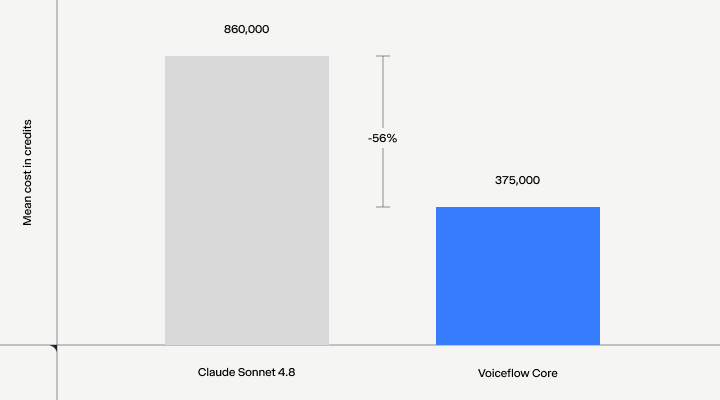
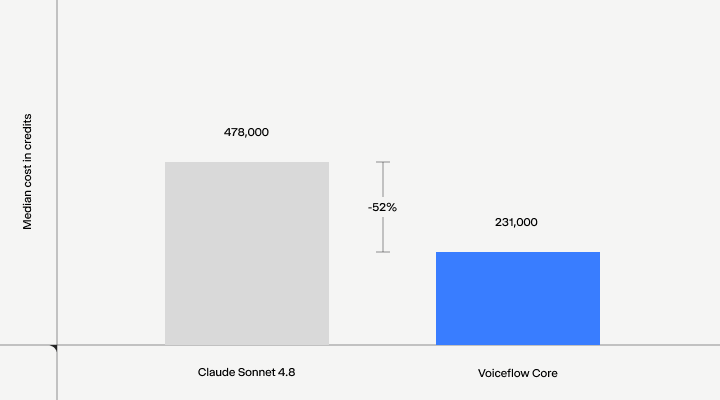
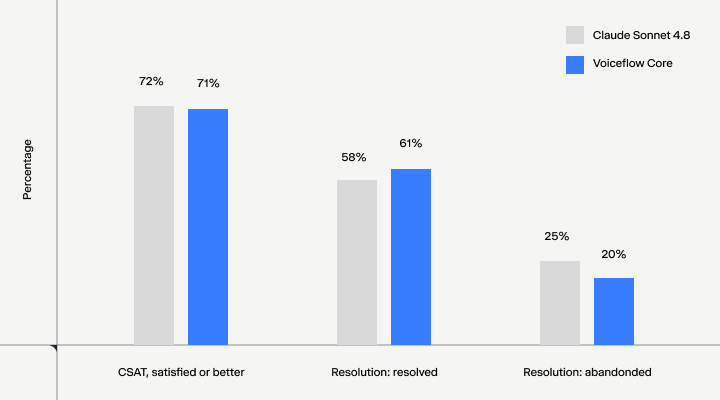
Half the cost. Same satisfaction. Better resolution.
A before/after on live traffic is a fair start, but it includes everything else that changed that week. So we also ran the clean version: we took real production transcripts and replayed them turn by turn against both models. Same conversations, same prompts, same tools. Only the model changed. In that matched comparison, Voiceflow Core came out about 3.5x cheaper for the same answers, with per-conversation savings between 1.6x and 4.2x.
And to be upfront about the caveats, because we'd rather you trust a careful number than admire a big one: the live comparison isn't an A/B (the swap shipped alongside some cost fixes of our own, which is why the replay number is the one that isolates the model), and credits are fat-tailed, so we quote the median. On list price alone, Voiceflow Core's output tokens run about 2.1x cheaper than Sonnet's. You can check the credits pricing table yourself. The production data is that gap showing up in real traffic.
Cheaper is easy. Reliability is the point.
Any model can be cheap. The reason we kept Voiceflow Core in production is what happened to the failure modes.
Before the switch, our ugliest cost problem wasn't the per-token price. It was the occasional runaway session, where the agent gets stuck re-searching the knowledge base and one conversation quietly burns more credits than the next hundred combined. You can see it in our duration data: after the swap, the median session length barely moved, but the mean fell 66%. Typical conversations didn't get shorter. The disasters disappeared. In our replay testing, Voiceflow Core produced zero runaway loops and zero empty responses.
The quality checks held up the same way. In our head-to-head evaluations, Voiceflow Core matched Sonnet on accuracy and stayed grounded in our docs, including on the hallucination probes we designed to bait a wrong answer (made-up pricing, features we don't have). It kept its fluency across languages. And it follows instructions deep into long conversations, which is where agent quality usually goes to die.
That's what we mean by tuned for agent work. Not a benchmark story. A model that behaves predictably on turn forty, calls tools cleanly without narrating them, and doesn't set your budget on fire when a conversation gets weird.
Don't take our word for it. Run the loop.
Everything above is our data, from our agent. Yours will differ. The good news is that finding out is not a leap of faith anymore.
We've written before about the AI Agent Observability Loop: visibility into what your agent is doing, insight from evaluations, optimization in an isolated environment, and deployment once the evidence is in. A model swap is just one trip around that loop. Here's how we ran it:
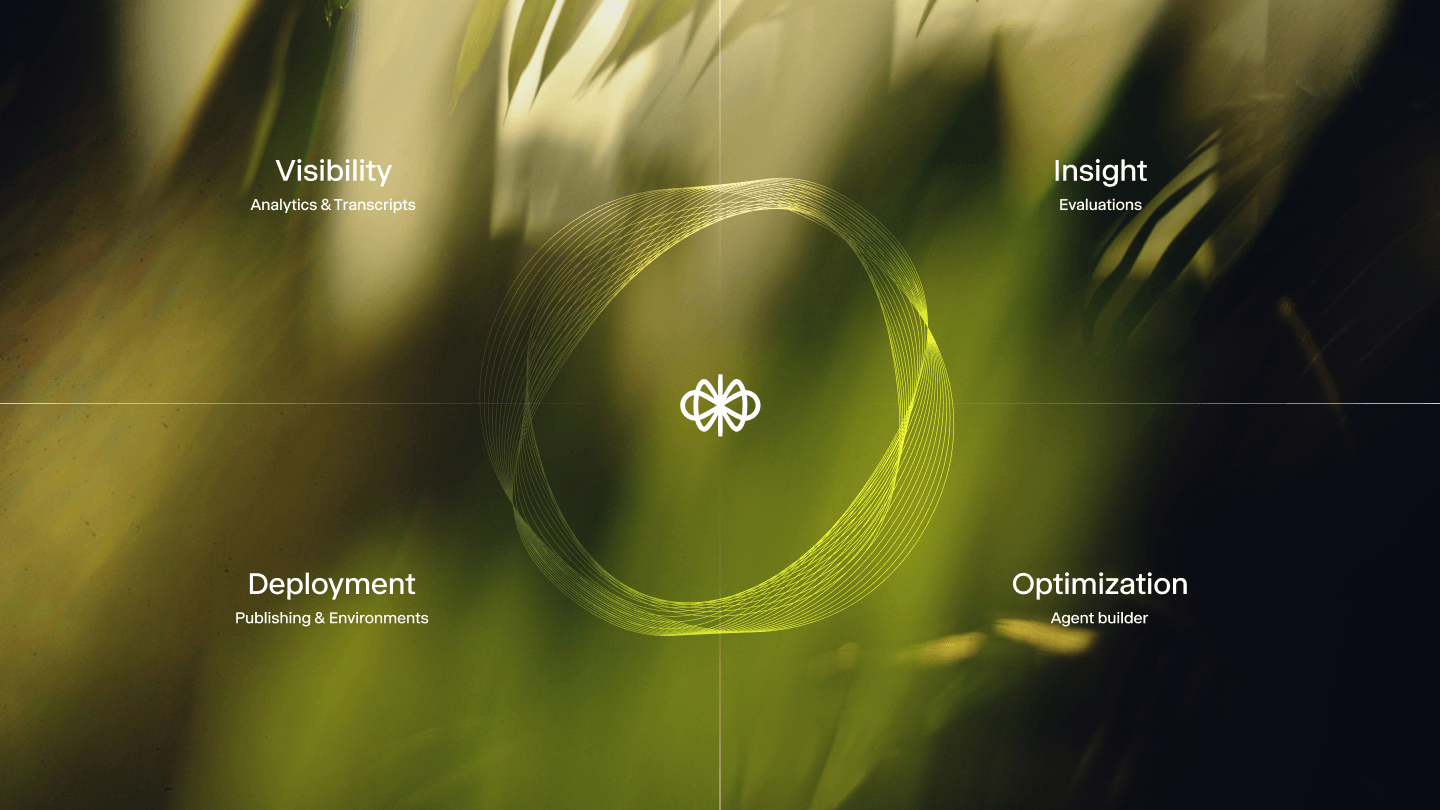
Visibility: Your transcripts are the ground truth. Pull real production conversations, because that's what the new model has to survive. Not a demo script.
Insight: Run evaluations on your transcripts if you haven't already. Resolution and CSAT are built in; custom criteria take minutes to write. This is your baseline, and without it a model swap is a vibes contest.
Optimization: Clone your agent into a fresh environment and change exactly one thing: the model. Then replay past conversations against it before any real user sees it. Did it reach the same answers? Call the same tools with the same arguments? What did each turn cost? This is where regressions get caught for free.
Deployment: Use the environment traffic split to send a slice of live traffic to the new arm. We ran 50/50. Let both sides accumulate eval scores on real conversations, then ramp the winner. Rollback is one click, back to 0%, no redeploy. We kept our old environment parked at 0% for weeks as a safety net and never needed it.
Swapping a model used to feel like a one-way door. Run it through the loop and it's a reversible experiment with a paper trail.
Try it
Voiceflow Core is a dropdown selection, per agent or per playbook, on every plan. If your agent runs real volume, an afternoon of testing will tell you more than this post can:
- Clone your environment and flip the model. Five minutes.
- Replay a handful of your own transcripts against it. An afternoon.
- If the answers hold up, split some traffic and let the evals decide. A week, passively.
Worst case, you set the split back to zero and you're out an afternoon of work. Best case, you cut your model bill in half and your resolution rate says thank you.
What's next
We're currently testing Voiceflow Core against the newest frontier models on live traffic, including a split against Claude Sonnet 5, and we'll publish what we find. And we’ll keep improving Voiceflow Core so you can build reliable agents for less.
We'll keep running our own support on Voiceflow Core, and we'll keep showing the receipts.