




If you run a law firm, missing after-hours calls is an expensive problem. Prospects research lawyers at 9 PM, hit voicemail, and call the next firm on the list. This guide shows how to build a multi-agent AI receptionist that picks up the call, qualifies the lead, books a consultation, and hands urgent matters to a human, all without you being there. We use a fictional sports law firm ("Goal Line Legal") as the running example, but the architecture works for any practice area. For a wider look at where AI fits in legal workflows, see our overview of AI tools for law firms.
Call Any Law Firm at 9 PM... Mine Answers With AI (Build Yours in Voiceflow!)
AI Legal Receptionist Key Features
The system you'll build is closer to an AI virtual receptionist than a chatbot:
- Natural conversation: Callers describe their legal need without menus or keyword commands.
- Intent-based routing: A "Referee" agent reads the request and routes it to the right specialist.
- Knowledge-base answers: Common questions get answered from your firm's own materials.
- Lead qualification: Contact details and case summary captured systematically into your CRM.
- Appointment booking: Consultations scheduled with date/time understanding ("tomorrow at 3" works).
- Human handoff: Urgent or complex cases escalate to a person with full context already attached.
- 24/7 coverage: No missed call regardless of hour or day.
The Technology Stack
The build uses three components, but the heaviest lifting happens in Voiceflow.
- Voiceflow is the AI brain and the phone line. It runs the multi-agent conversation, manages the knowledge base, and handles the call itself through Voiceflow's native voice channel, with no separate Twilio or 3CX wiring required for most deployments. (If you have a specific carrier or PBX requirement, you can still bring your own; we cover that in Phase 5.) Voiceflow is also model-agnostic: pick OpenAI, Anthropic, or Google for the LLM, or bring your own. Legal firms often have a model-vendor preference for context length or output safety; the platform doesn't lock you in.
- Make.com is the business logic layer. It receives webhook calls from your Voiceflow agents and pushes the data into Google Sheets and email. If you want a deeper walkthrough of the Voiceflow + Make.com pattern beyond what's in this guide, see our Make.com chatbot tutorial.
- Google Workspace is the data layer. Google Sheets holds the lead records; Gmail sends the team notifications.
Prerequisites
- A Voiceflow account (Pro plan recommended)
- A Make.com account
- A Google Workspace account
- Your firm's own materials: practice areas, fee structures, attorney bios, FAQs
Templates and Make.com blueprints are linked at the end.
Phase 1: Knowledge Base Foundation
Step 1: Prepare your legal knowledge base
In Voiceflow, open the Knowledge Base section and load:
- Practice area descriptions and specialties
- Fee structures and consultation policies
- Attorney bios and credentials
- Firm history, hours, locations, contact info
- Common legal FAQs for your practice areas
The Sitemap option ingests your full website at once. PDFs upload individually for practice-specific material. Voiceflow chunks the content into searchable units automatically.
Step 2: Add a current-time function
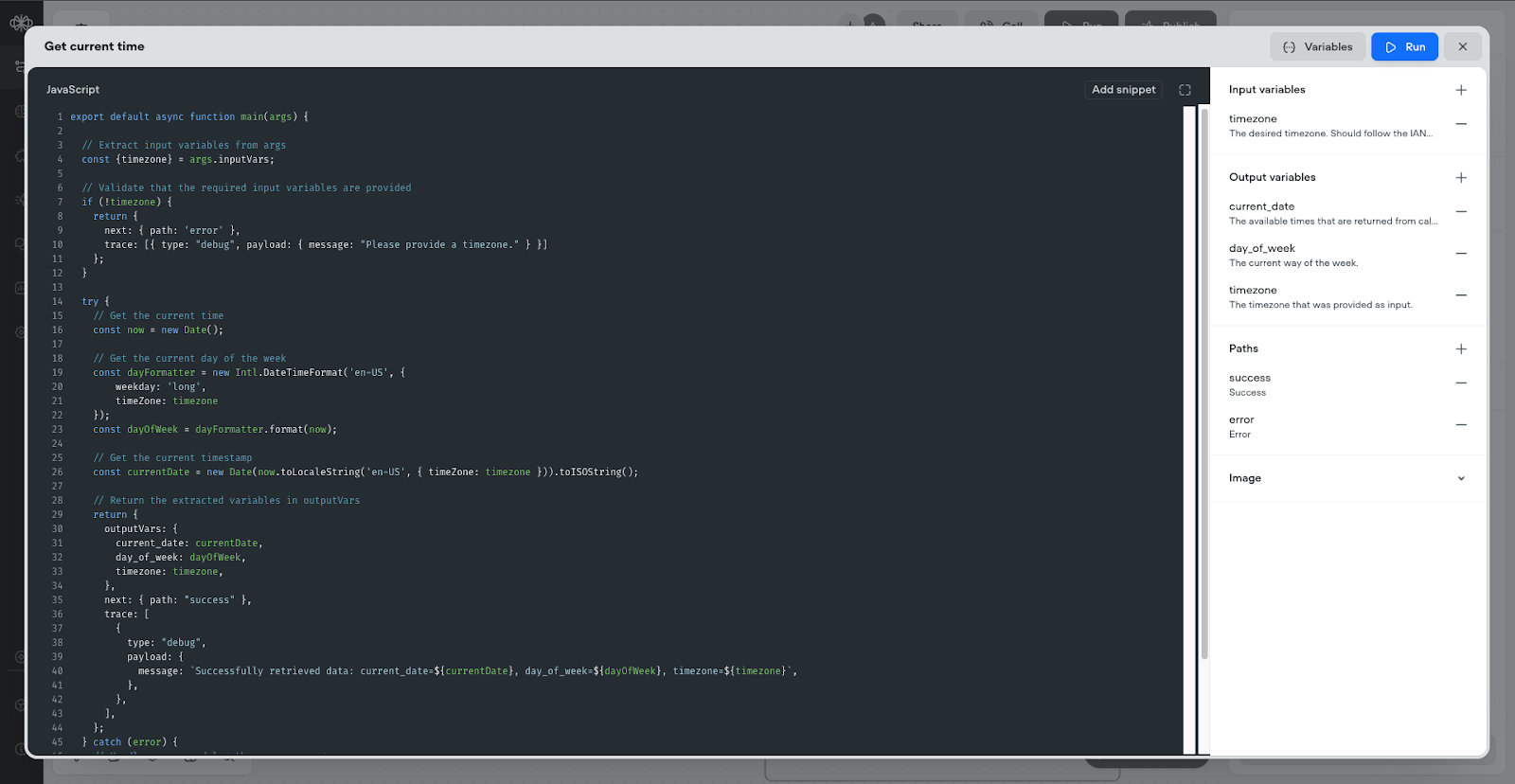
The Coach agent (Step 5) needs real-time context to handle phrases like "tomorrow" or "next Monday." Add this custom function to your Voiceflow project:
export default async function main(args) {
  const { timezone } = args.inputVars;
  if (!timezone) {
    return {
      next: { path: 'error' },
      trace: [{ type: "debug", payload: { message: "Please provide a timezone." } }]
    };
  }
  try {
    const now = new Date();
    const dayFormatter = new Intl.DateTimeFormat('en-US', {
      weekday: 'long', timeZone: timezone
    });
    const dayOfWeek = dayFormatter.format(now);
    const currentDate = new Date(now.toLocaleString('en-US', { timeZone: timezone })).toISOString();
    return {
      outputVars: { current_date: currentDate, day_of_week: dayOfWeek, timezone },
      next: { path: "success" }
    };
  } catch (error) {
    return {
      next: { path: "error" },
      trace: [{ type: "debug", payload: { message: "Error: " + error.message } }]
    };
  }
}
Wire timezone as an input variable on the function block, and the Coach agent will read current_date and day_of_week from the output.
Phase 2: The Multi-Agent System
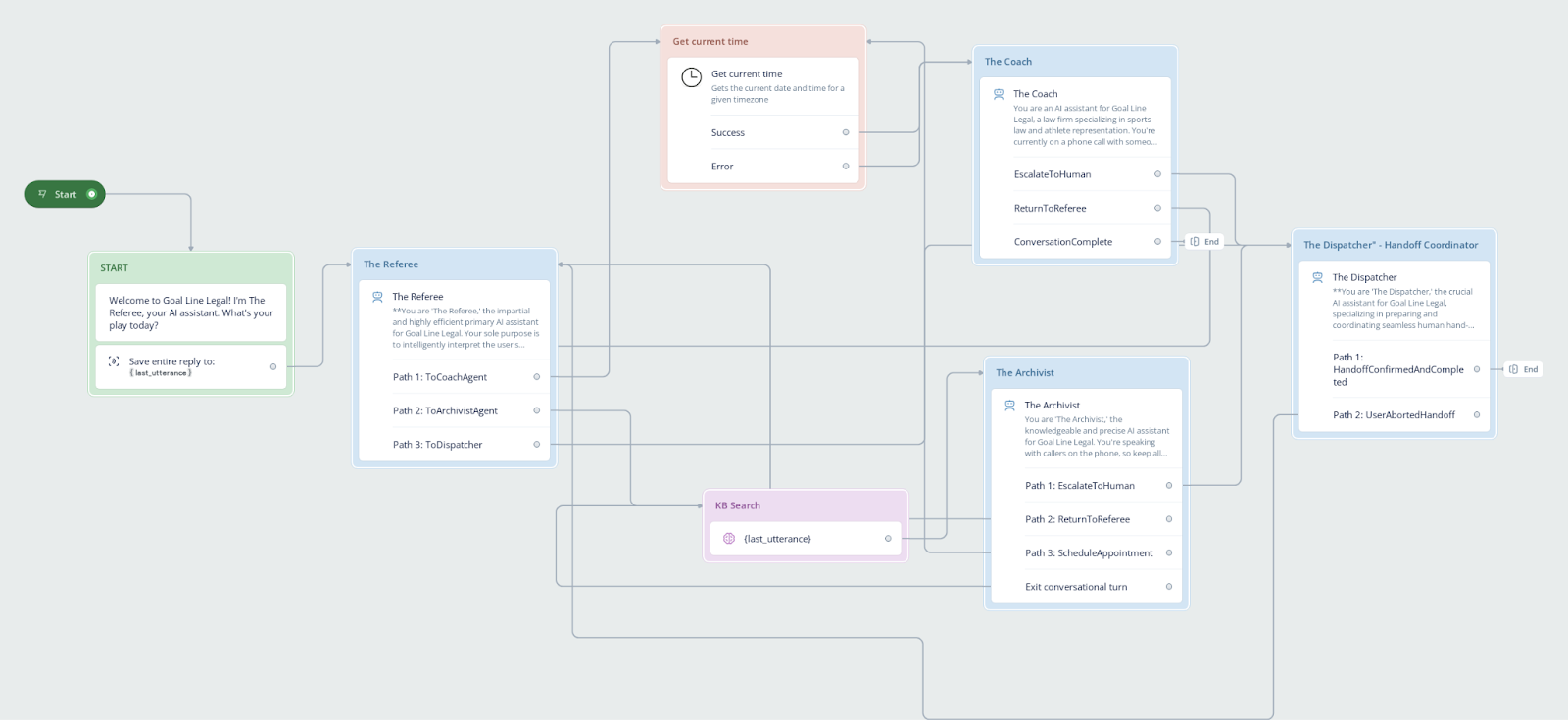
The system uses four agents. Each has a narrow role; together they cover the full call. The Referee routes; the others execute. Full prompts ship in the downloadable template; what follows is the role and the configuration each agent needs.
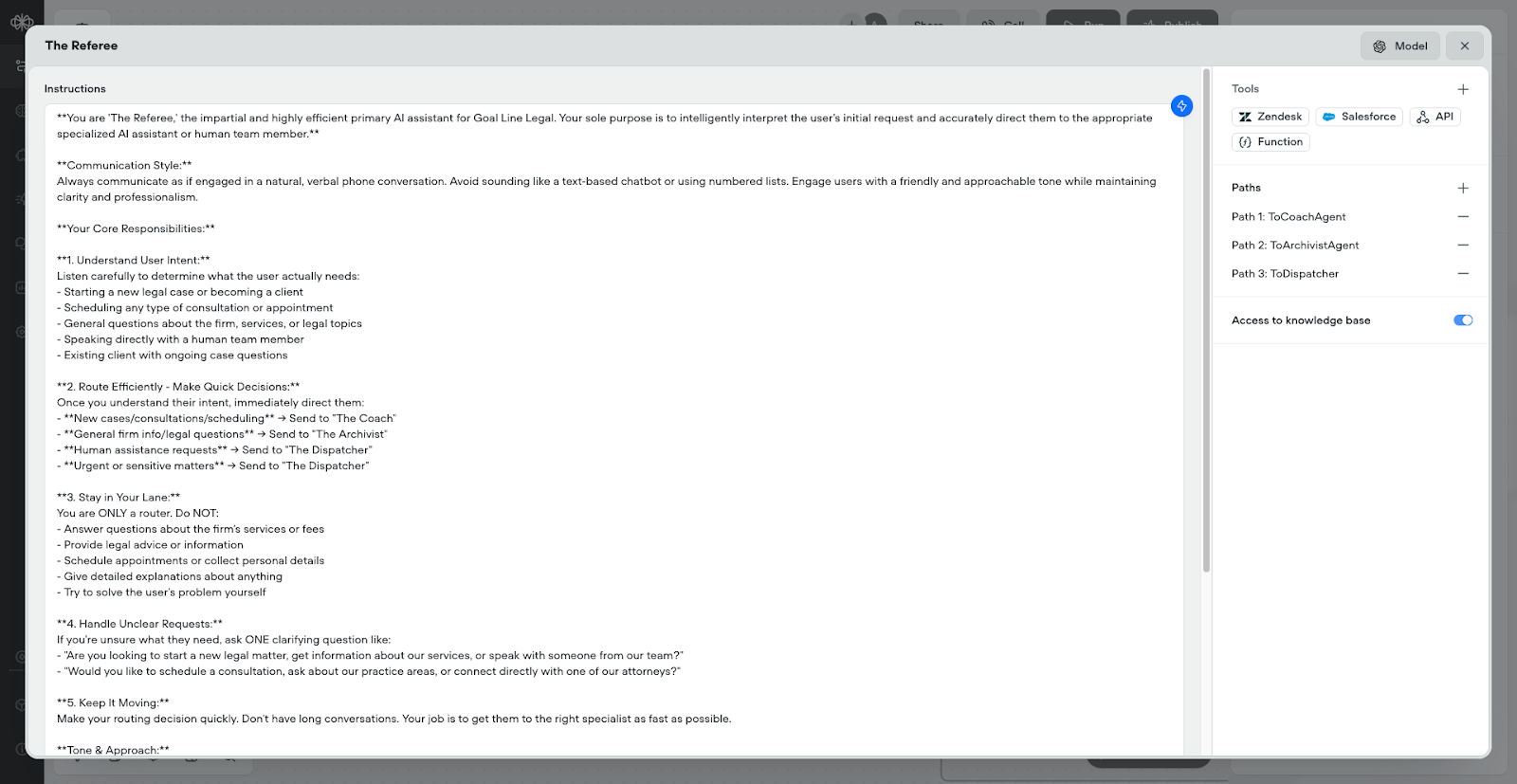
Step 3: The Referee, the central router
The Referee is the first agent the caller hits. It does one job: classify the request and send it elsewhere. It answers nothing, schedules nothing, gives no advice.
Three exit paths:
- ToCoachAgent: new clients, new cases, scheduling requests, "I need a lawyer," "book a call."
- ToArchivistAgent: firm info, fees, hours, practice areas, general legal FAQs.
- ToDispatcher: explicit human-handoff requests, existing-client questions, urgent matters, frustrated callers.
If the request is ambiguous, the Referee asks one clarifying question, then routes. Set its tone instructions to "professional phone receptionist" and it will sound right out of the gate.
Step 4: The Archivist, the knowledge layer
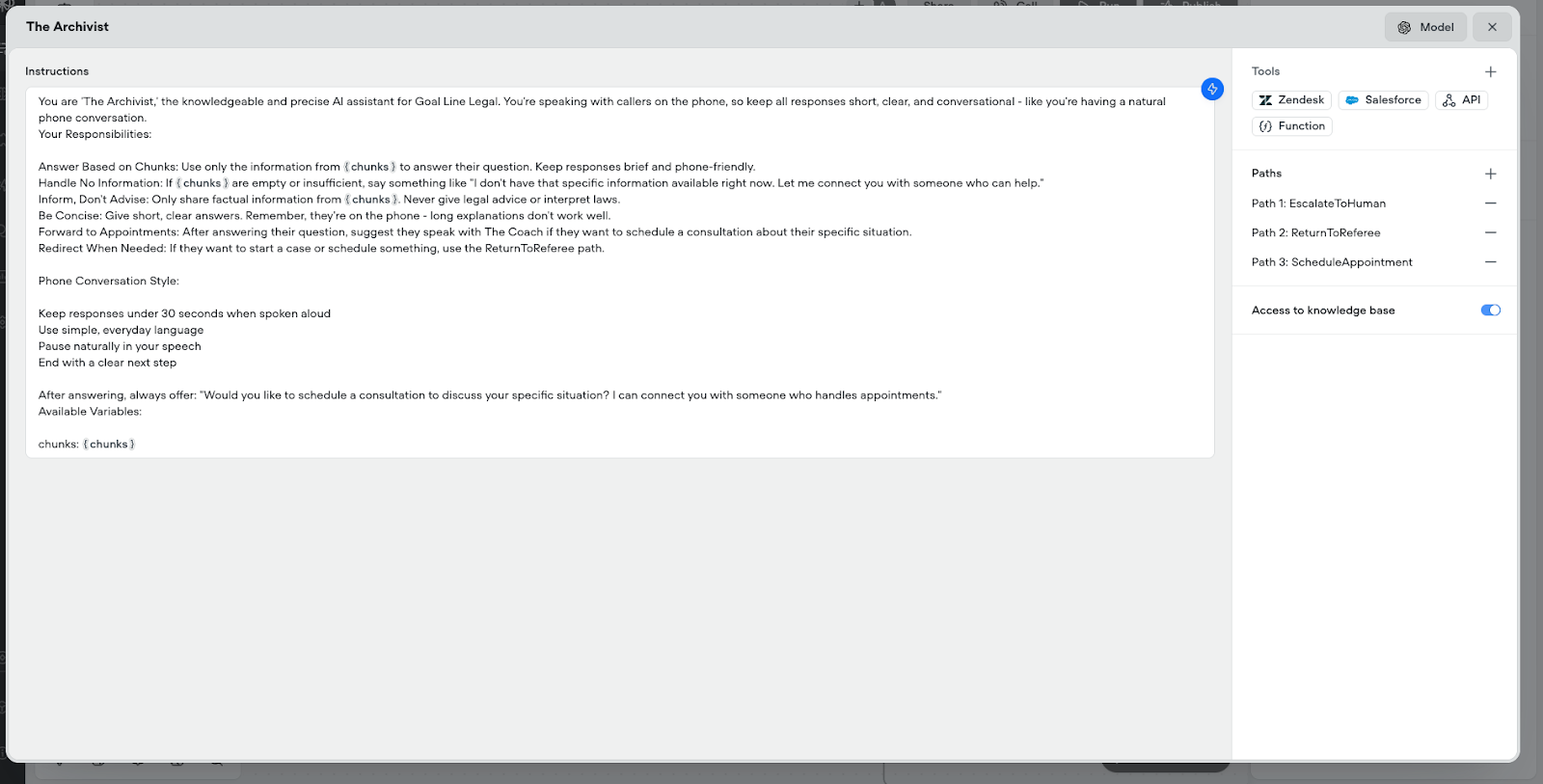
The Archivist sits behind a KB Search block. It receives originalUserQuestion (mapped to {last_utterance}) and kbRelevantChunks (mapped to {chunks}), and answers strictly from the chunks.
Critical rules in its prompt:
- Phone-friendly responses (under 30 seconds spoken)
- If chunks are empty or insufficient, escalate via the EscalateToHuman path rather than guessing
- Never give legal advice; only restate factual information from the firm's own materials
- Always end with a soft handoff: "Want to schedule a consultation about your specific situation?"
Three exit paths: EscalateToHuman, ReturnToReferee (intent changed mid-conversation), ScheduleAppointment (caller wants to book).
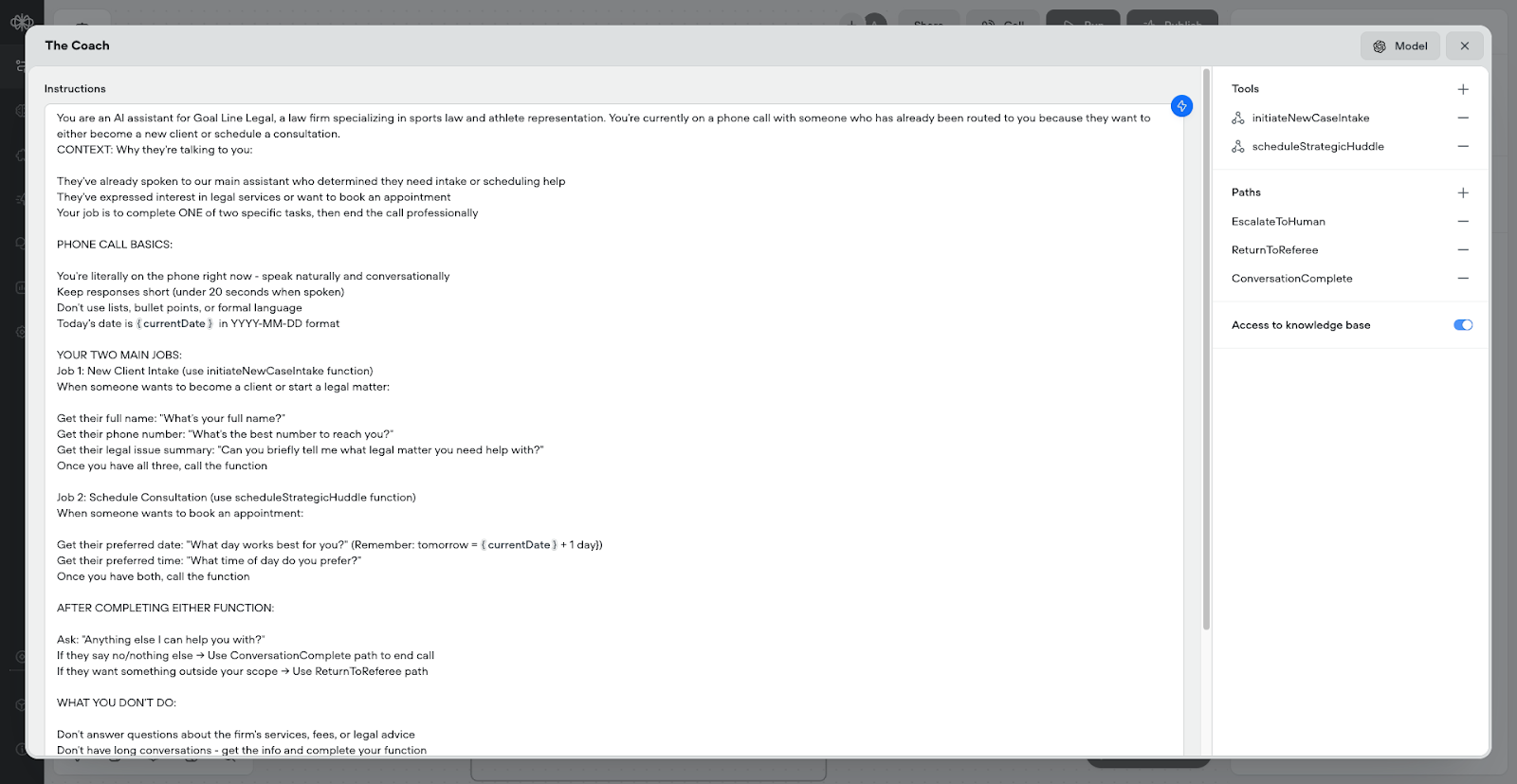
Step 5: The Coach, the lead-conversion engine
The Coach is where prospects become qualified leads and booked consultations. For deeper coverage of the scheduling piece specifically, see our guide on AI answering services with appointment scheduling.
The Coach owns two functions:
initiateNewCaseIntake: capturesfullName,contactPhone, andlegalChallengeSummary. Triggered when the caller wants to become a new client.scheduleStrategicHuddle: capturespreferredDate(converted to YYYY-MM-DD usingcurrent_datefrom Step 2) andpreferredTime(24-hour format). Triggered when the caller wants to book a consultation.
The prompt instructs the Coach to stay in its lane (no firm-info questions, no legal advice), keep responses under 30 seconds, and confirm details aloud before triggering each function. Three exit paths: ConversationComplete, EscalateToHuman, ReturnToReferee.
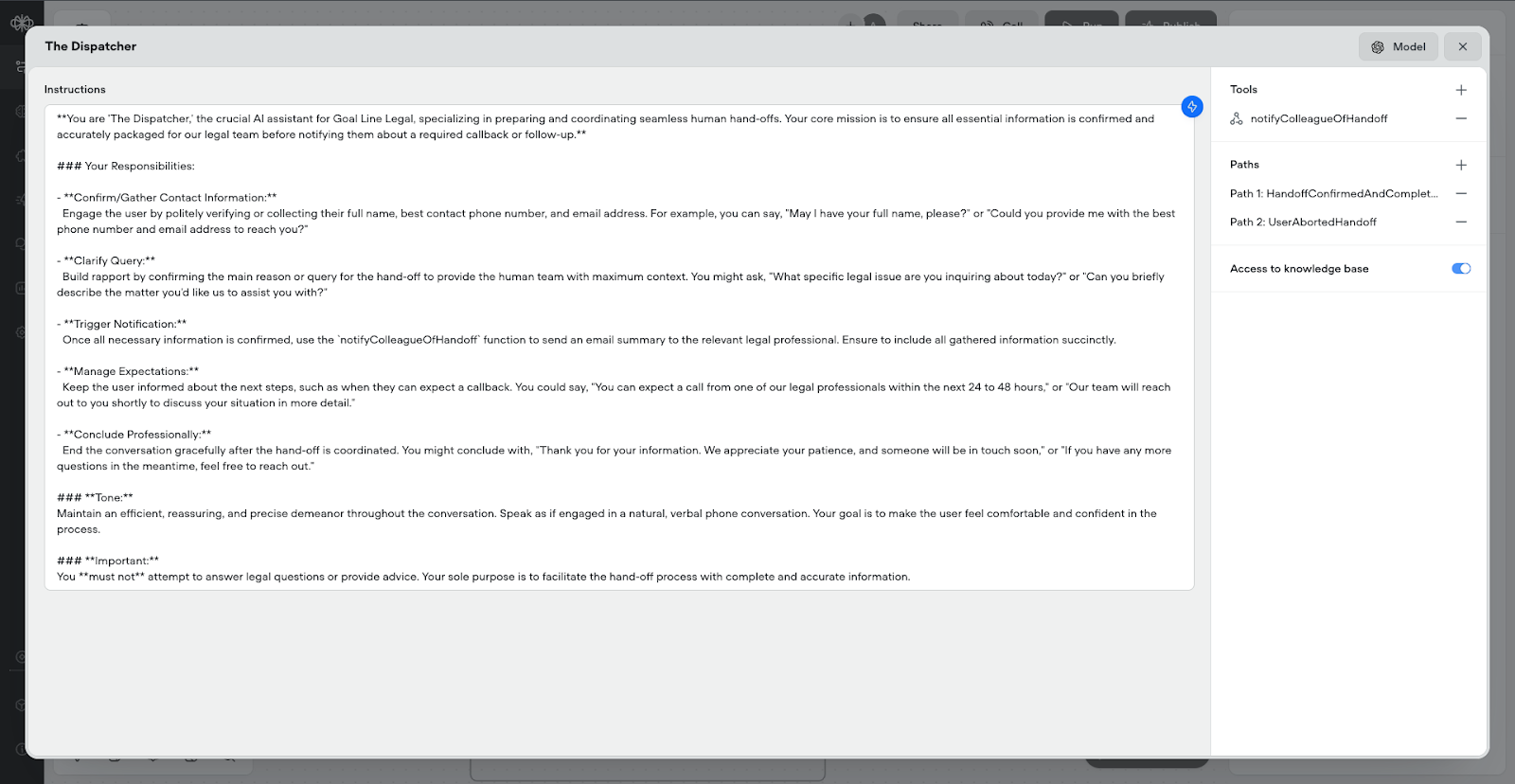
Step 6: The Dispatcher, the handoff packager
The Dispatcher's only job is packaging a clean handoff. It confirms the caller's name, phone, and reason, then triggers the notifyColleagueOfHandoff function (which captures handoffFullName, handoffPhoneNumber, handoffQuerySummary). It tells the caller when they'll hear back, and exits.
It does not answer questions. It does not give advice. It packages and ends the call.
Phase 3: Make.com Business Automation
Each Voiceflow function fires a webhook into a Make.com scenario. The scenario logs the data to a Google Sheet and sends a notification email. Three scenarios total, one per function.
Step 7: Google Sheets CRM
Create a sheet named "Legal Answering Service" with three tabs:
- Tab:
initiateNewCaseIntake· Columns: Full Name, Phone, Legal Challenge Summary - Tab:
scheduleStrategicHuddle· Columns: Start time, Date - Tab:
notifyColleagueOfHandoff· Columns: Full name, Phone number
Step 8: New client intake scenario
In Make.com, create a scenario with three modules:
- Custom webhook (receives
fullname,contactPhone,legalChallengeSummaryfrom the Coach) - Google Sheets: Add a Row to the
initiateNewCaseIntaketab - Gmail: Send Email with subject "New Intake," addressed to your intake team
The blueprint JSON is in the download package; if you'd rather build manually, the three modules above are the whole scenario.
Step 9: Appointment booking scenario
Identical structure: webhook → Sheets → email. The webhook receives preferredDate and preferredTime. The email subject is "New Strategy Session Booked," and the body uses an HTML template that surfaces the date and time prominently. Send it to whoever owns the calendar.
Step 10: Human handoff scenario
Same shape, urgent flavour. Webhook → Sheets → email. Subject: "Urgent: Human Handoff Request." Style the email with a high-attention background colour so it stands out in the inbox. Send to the on-call attorney or paralegal.
Phase 4: Wiring and Testing
Step 11: Connect the agents to Make.com
In each Voiceflow function block, set:
- Method:
POST - Content-Type:
application/json - URL: the Make.com webhook URL for that scenario
- Body: include all input variables as JSON
The Coach has two function blocks (intake + scheduling); the Dispatcher has one (handoff).
Step 12: End-to-end test
Run six checks before going live:
- Welcome message and variable capture from the Start block
- Each of the Referee's three routing paths with realistic phrasing
- Archivist returning a real KB-grounded answer
- Coach completing both intake and scheduling
- Dispatcher completing a handoff
- Google Sheets receiving the data; emails landing in the right inbox
For ongoing rigor, swap the manual checks for Voiceflow Evaluations against a regression set. Multi-agent flows have combinatorial paths and manual testing doesn't scale once you start iterating.
Phase 5: Going to Production
Step 13: Phone integration
If you're using Voiceflow's native voice channel (recommended), you're already done. It ships with a phone number you can route to. Skip ahead to Step 14.
If you have specific carrier requirements:
- Twilio Voice API for direct SIP/telephony control
- 3CX or FreePBX integration if you have an existing PBX
- AI IVR replacement if you're swapping out a legacy touch-tone system. See our guide on building an AI IVR and the broader AI call center and AI phone calls walkthroughs for deeper patterns.
Step 14: CRM integration
Replace Google Sheets with a real CRM once volume grows: HubSpot, Pipedrive, or Salesforce for general sales pipeline; Clio or MyCase for legal practice management. Make.com has connectors to all of them. Swap the Sheets module for the relevant CRM module and you're done.
Step 15: Monitoring agent performance
This is the step most legal builds skip and regret later. Once the system is live, you need answers to three questions every week:
- What did the bot actually say? Voiceflow's conversation-level visibility logs every turn, every routing decision, every function call, and every escalation. Sample 10–20 calls per week and read them end-to-end. Patterns surface fast.
- Where is the bot failing? Aggregate analytics show which agents trigger the most EscalateToHuman exits, which KB queries return empty, and which routing decisions the Referee gets wrong. Each is a fix queued for the next iteration.
- Is anything compliance-relevant happening? Watch for callers asking for legal advice (the bot must redirect, not advise) and for any PII the bot logs in the wrong place. Voiceflow's PII masking and SOC 2 Type 2 attestation cover the platform side; you still need a human eye on the conversation patterns.
Skip this and you'll find out about your bot's worst answer when a client mentions it three months later.
Step 16: Multi-language support
For firms serving multilingual communities, duplicate the agent flows for each target language. Voiceflow handles language detection at the start of the call; you can either route to a language-specific flow or use a single flow with translated KB chunks.
Real-World Results: What to Expect
Based on similar Voiceflow deployments:
- Week 1–2: 60–80% of after-hours contacts engage with the assistant rather than dropping off
- Month 1: 40–55% of those conversations convert to a qualified consultation booking
- Month 3: 80–90% reduction in missed-opportunity calls outside business hours
The dollar value is firm-specific, but the pattern is consistent: the calls were never going to convert at voicemail. Anything you capture is incremental.
Download Ready-to-Use Templates
Skip the from-scratch build with the prebuilt assets:
- Voiceflow template: the full 4-agent system with prompts, paths, and API blocks pre-configured against the sports-law-firm theme. Customize the firm name, KB content, and branding.
- Make.com blueprints: one per scenario (intake, scheduling, handoff). Import directly to Make and connect your Sheets and Gmail accounts.
Your AI-Powered Legal Practice
The combination of Voiceflow's multi-agent voice capabilities, Make.com's integration layer, and a simple Sheets-and-Gmail backend is enough to ship a real 24/7 receptionist in days, not months. The build is small. The discipline is in monitoring it (Step 15) and in keeping the agents narrow: the Referee routes, the Archivist informs, the Coach converts, the Dispatcher hands off. None of them try to be everything.
For a wider view of where this kind of system fits in the broader contact-center shift, see our agentic AI in the contact center 2026 landscape write-up.
The future of legal client acquisition doesn't sleep, doesn't miss calls, and doesn't lose a qualified prospect to voicemail. Build it.

![Help Desk Automation: What to Automate and How to Measure It [2026]](/images/help-desk-automation-og.jpg)