



![Stack AI: What It Is and Best Alternatives [2026]](/images/stack-ai-04fed7f8-hero.webp)
Stack AI raised a $16 million Series A in May 2025 led by Lobby Capital, with new investors LifeX Ventures, Vercel CEO Guillermo Rauch, and Weaviate CEO Bob Van Luijt joining returning backers Y Combinator and Gradient. The MIT-founded startup now positions itself as "AI Agents for the Enterprise", serving F500 customers like Nubank, LifeMD, Cardlytics, Granite Inc, and MIT Sloan after a 2024 strategic pivot away from SMB.
This article covers what Stack AI does today, how the product works, what it costs, where it fits in the broader AI agent builder landscape, and the best alternative for teams building customer-facing conversational agents rather than back-office workflows.
What Is Stack AI?
Stack AI is an enterprise platform for building and deploying AI agents that automate workflows across data, large language models, and back-office systems. The company started in 2022 with a workflow-automation framing, but its 2025 positioning rebrand to "AI Agents for the Enterprise" reflects how the product has moved into the broader agentic AI category.
The core strength is connecting various tools, particularly data sources and Large Language Models, into automated workflows that take real actions: retrieving from knowledge stores, drafting documents, processing forms, or routing tasks across enterprise systems.
Stack AI's Founders
Stack AI was co-founded in 2022 by Antoni Rosinol (CTO), Bernardo Aceituno (CEO), and Melissa Forstell, all with MIT roots. Rosinol and Aceituno were PhD students at MIT; the founding team recognized the potential of large language models before ChatGPT shipped, identifying a gap in the market for tools that combine data sources with LLMs to drive enterprise workflows.
Aceituno has been the public face of Stack AI's enterprise transformation. The pivot from SMB to enterprise (covered in detail below) and the company's "AI Agents for the Enterprise" positioning both came from his strategic direction.
Stack AI Funding
Stack AI has raised approximately $19.6 million across two rounds:
- Seed (2023): $3 million led by Gradient Ventures, with Y Combinator, Beat Ventures, True Capital, Lambda Labs, Soma Capital, and Epakon Capital
- Series A (May 2025): $16 million led by Lobby Capital and LifeX Ventures (both new), with new participation from Guillermo Rauch (CEO of Vercel) and Bob Van Luijt (CEO of Weaviate). Y Combinator, Gradient Ventures, and Epakon Capital returned as existing investors.
The Series A came on the back of strong enterprise growth (covered below) and signals that Stack AI is now well-funded for an extended enterprise sales motion through 2026 and beyond.
Stack AI's Customers and Growth
Stack AI now serves 100+ enterprise customers with named logos including Nubank, LifeMD, Cardlytics, Granite Inc, and MIT Sloan. The customer base spans F500 companies, healthcare providers, government agencies, and academic institutions.
Reported metrics from the 2025 Series A: 8× revenue growth year-over-year, with enterprise sales cycles closing in 2 to 6 weeks. These numbers reflect a deliberate 2024 strategic shift.
Stack AI fired its SMB customers and pivoted entirely to enterprise. Co-founder and CEO Bernardo Aceituno has discussed the decision on record: the company looked at unit economics, sales cycles, and product fit, and decided to focus exclusively on F500-scale buyers. The move drove the 8× enterprise growth and shapes everything about the current product. Pricing is enterprise-only. Support is concierge-tier. Roadmap priorities track F500 procurement requirements: SOC 2, compliance, deep integrations with enterprise systems like Salesforce, Snowflake, and AWS.
For buyers evaluating Stack AI today, this shift is the single most important signal. If you're not an enterprise buyer, you're not the audience. If you are, the platform has been hardened around your procurement and deployment expectations.
How Does Stack AI Work?
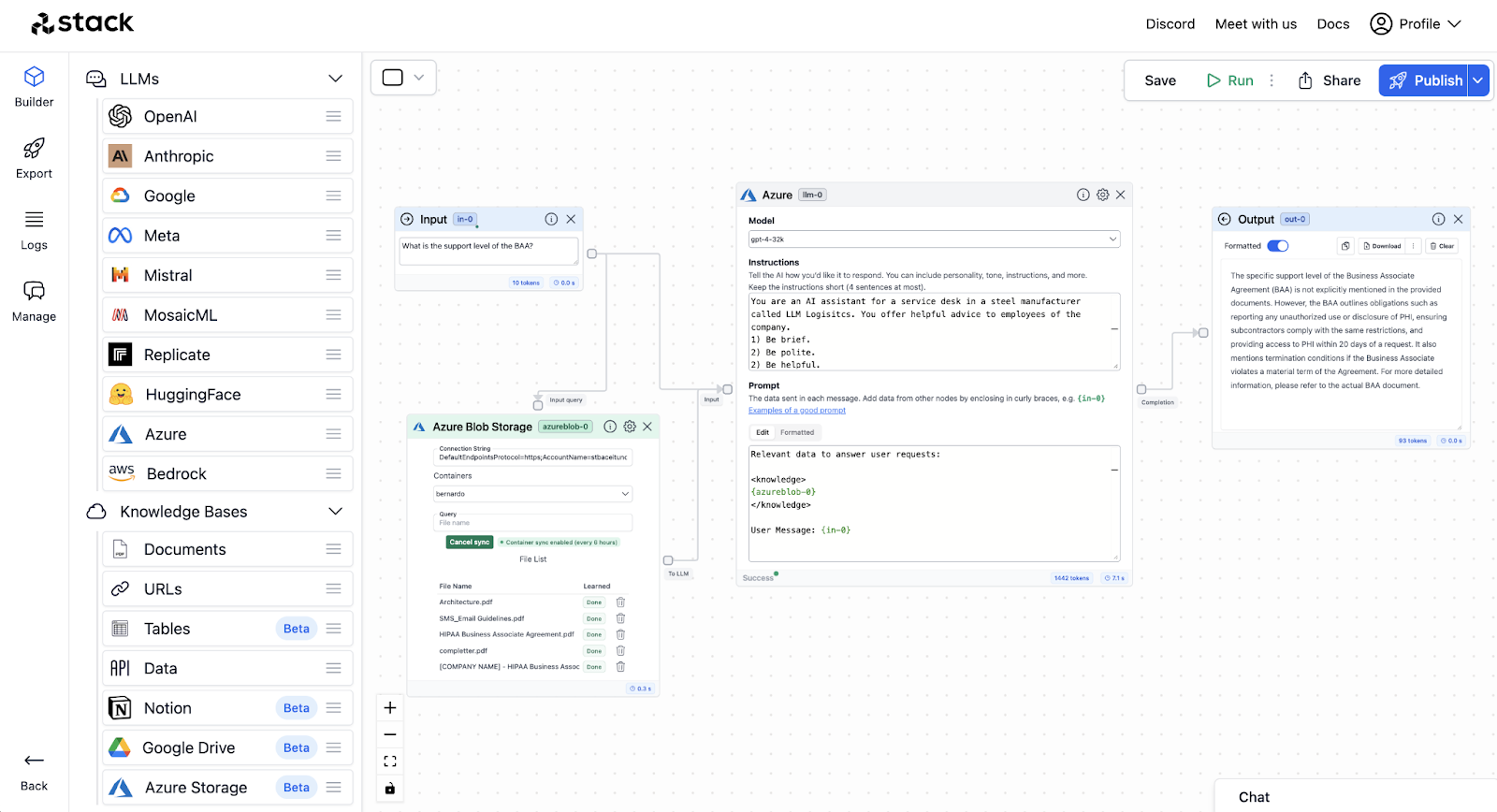
At its core, Stack AI is a low-code platform for connecting data sources, LLMs, and enterprise systems into agent-driven workflows. Users build through a drag-and-drop visual interface, then deploy via custom UI or API endpoints.
Knowledge Base and Retrieval
Stack AI ingests internal documentation, support transcripts, data warehouses, and structured records to power its agents. The retrieval layer is part of the managed setup. Stack AI's deployment team typically helps tune chunking strategy, embeddings, and retrieval prompts to fit the customer's data shape. This contrasts with bring-your-own-knowledge base platforms where the customer's team owns retrieval logic end to end. For F500 customers without dedicated AI engineering teams, having Stack AI co-own retrieval is appealing. For teams that want to iterate on retrieval themselves, it's a constraint.
What Can You Build with Stack AI?
The platform's enterprise focus translates into back-office workflow automation across regulated and operational verticals. Real production deployments cluster around six categories:
- Operations. AI assistants automate supply-chain tasks, generate proposals, respond to RFPs, and optimize logistics by processing large datasets to provide actionable insights in real time.
- Analytics. Teams deploy AI agents that reduce dependency on data analysts by enabling natural language queries. Stack AI gives teams direct access to insights from data warehouses without going through a BI team.
- Healthcare. Physician co-pilots retrieve patient history, treatment plans, and progress notes from electronic health records. AI agents also automate SOAP-note generation from recorded patient visits, reducing administrative burden.
- Legal. Legal teams automate document review, draft briefs, and analyze contracts. Stack AI processes large legal document corpora to identify key information across cases.
- Customer Service. Stack AI builds customer-service assistants that handle common queries, provide instant responses, and escalate complex issues to humans. For teams whose primary use case is customer-facing conversation (particularly with voice), see AI customer service agents and conversational AI platforms as alternative category fits.
- Finance. AI agents monitor transactions for fraud, automate financial reporting, and manage compliance. Real-time financial insights help organizations maintain accurate records while meeting regulatory requirements.
The pattern across these verticals is consistent: Stack AI's strength is back-office workflow automation, often in regulated environments where the value proposition is "do the work agents can do so humans can focus elsewhere." For teams looking to replace legacy chatbots with AI agents in customer-facing contexts, the better fit is often platforms purpose-built for conversational AI. For teams looking at vertical AI agents tuned to a specific industry, the right pick depends on how much customization the vendor will own versus your team.
Stack AI Pricing
Stack AI doesn't publish pricing. Following the 2024 enterprise-only pivot, all deals route through enterprise sales with custom contracts tied to:
- Seat count and user tier. Standard enterprise-software seat-based pricing.
- Model usage volume. Per-call or per-conversation pricing across the underlying LLM providers.
- Integration scope. Custom integrations with enterprise systems (Salesforce, Snowflake, custom data warehouses, internal APIs) carry separate scoping.
- Managed-service tier. How much of the ongoing agent operations Stack AI's team owns vs. your in-house team.
Buyers should plan for a 5- to 6-figure annual minimum and a 60- to 90-day procurement cycle. The lack of published pricing is consistent with the enterprise CX/automation category and the post-2024 strategic shift. The value proposition is "we'll build and operate the agent with you," not "we sell you software you operate."
By contrast, Voiceflow offers a free trial with usage-based billing, so teams can prototype and validate the platform before booking sales calls. Teams running ROI math on enterprise AI customer service typically benefit from a free-trial validation step before committing to enterprise procurement.
Things to Know About Stack AI
Stack AI's strengths are clear: enterprise-grade managed deployment, named F500 customers across regulated verticals, 8× growth in 2025, and a focused product surface for back-office workflow automation. The tradeoffs:
- Enterprise-only motion. After the 2024 pivot, Stack AI no longer serves SMBs. If you're a small team or solo, you're not the buyer.
- Workflow-first, not customer-facing. Stack AI shines for back-office automation (operations, analytics, legal, finance, healthcare). Teams that need customer-facing conversational AI evaluate against enterprise AI chatbots instead.
- API-first deployment. Customizable UI exists but the dominant deployment is via API endpoint or embedded web app. Teams that need polished chat widgets or native voice chatbots need different tooling.
- Pricing opacity. Enterprise sales motion. Plan for a 60- to 90-day procurement cycle.
- Workflow vs agent framing. Stack AI is repositioning as "AI Agents for the Enterprise," but the historical product surface is more workflow automation than autonomous agent. Verify your use-case fit during evaluation.
- Observability through integration. Production AI deployments need AI agent observability (span-level traces, custom evaluations, regression testing). Stack AI typically integrates with external eval tooling rather than shipping it natively. Platforms with built-in observability reduce that integration burden.
These aren't reasons to dismiss Stack AI. For the right buyer (F500 enterprise, back-office workflow automation use case, willing to engage enterprise sales), the platform is a strong fit. They're the buyer-evaluation questions any procurement team will surface during a 90-day cycle.
Stack AI's Best Alternative: Voiceflow
Stack AI and Voiceflow are different products for different use cases. Stack AI is built for back-office workflow automation in regulated verticals (legal, finance, healthcare, operations). Voiceflow is built for customer-facing conversational AI across chat and voice. The right pick depends on what kind of agent you're building.
Stack AI vs Voiceflow At a Glance
Why Teams Pick Voiceflow Over Stack AI
You're building customer-facing, not internal. Voiceflow is purpose-built for conversational customer experience: support, lead capture, voice agents, e-commerce. Stack AI's strength is internal back-office automation. If your use case is a customer-facing chat or voice agent, Voiceflow is the more natural fit.
Voice or multi-channel is part of your roadmap. Voiceflow ships native voice from day one: IVR replacement, restaurant phone agents, healthcare triage, and customer-service voice across the same platform as chat. Stack AI's product began and remains rooted in workflow automation, with voice as a more API-driven afterthought. For teams in airlines, financial services, restaurants, healthcare, or travel, voice is often the higher-volume channel.
You want to choose your model. Voiceflow is model-agnostic: pick any major provider (OpenAI, Anthropic, Google) or bring your own. Stack AI manages model selection under the hood. If your procurement, legal, or security team has constraints on which models can touch customer data, model choice matters.
You want to try it before you commit. Voiceflow offers a free trial with usage-based billing; business pricing is quoted. Teams can prototype, evaluate, and validate the platform before booking sales calls. Stack AI's enterprise-only motion adds a 60-90 day procurement cycle to evaluation.
You're benchmarking the broader AI agent landscape. If you're also looking at the best AI agent builders or comparing AI agent frameworks, Voiceflow is consistently the platform that lets your team keep the most control over how the agent works.
What Voiceflow Is In One Paragraph
Voiceflow is the platform for building, launching, and scaling AI agents (chat and voice) across customer channels. Used by both no-code teams (designers, CX leads) and developers building custom integrations via API. Trusted by 250,000+ teams, including Turo, StubHub International, Sanlam Studios, and Trilogy. Trilogy used Voiceflow to automate 60% of L1 and L2 support tickets with an AI agent powered by a curated knowledge base. That kind of outcome is possible when your team owns the agent and iterates on it directly.
Ready to evaluate the platform? Request a Voiceflow enterprise demo to see how your team can build, deploy, and own customer-facing AI agents at enterprise scale.
![Decagon AI: How It Works & Best Alternative [2026]](/images/decagon-ai-9fbaf508-og.jpg)
![AgentGPT: What It Is and Best Alternative [2026 Review]](/images/6a43cdf884b9f5c287faa30c_6a43cdf75445be6f668e4ab6_agentgpt-hero.webp)