Voiceflow named a 2026 Best Software Award winner by G2
Read now

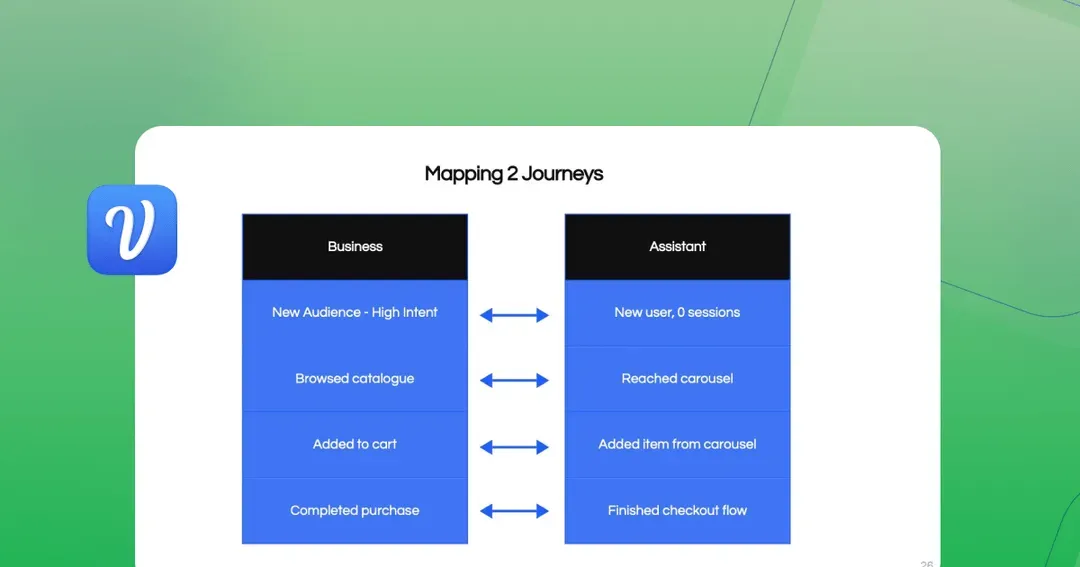
The framework includes three key parts: business journey milestones, assistant journey milestones, and map out business and assistant journeys.
Here’s an example of using the framework for a retail shopping experience focused on activating new sign-ups towards a first purchase.
Step 1
Write down the business journey milestones that the overall team cares about and tracks.
For the retail business, a few examples might look like:
Step 2
Identify the assistant journey milestones in relation to the business milestones from Step 1.
The conversational journey milestone might look like this:
Step 3
Now that you have both the business and conversational journeys that matter plotted out to analyze, it’s time to map the both.
You’ll notice that your assistant either 1) has many high intent buying moment that you haven’t recognized or 2) needs additional design work to better map to the customer buying journey.
The framework then would ideally look something like this:

The established buying journey now has a tangible touchpoint within the assistant which is measurable and trackable.
Product, revenue, and conversational AI teams can then all rally behind creating a great customer experience that is trackable and mapped back to revenue at key points. Best of all, conversation design teams will start to see how much of a true impact their assistant has on customer experience and buying behavior in comparison to other business channels.
Ready to make these ROI design decisions easier? Chat with our team.


.avif)
.avif)