Voiceflow named a 2026 Best Software Award winner by G2
Read now


AI agents are rapidly becoming foundational systems in the modern customer experience stack.
Analysts already see this shift accelerating. Gartner predicts that by 2026, more than 40% of enterprise applications will include AI agents, up from less than 5% today.
Unlike traditional CX automation that’s built on predefined scripts and sequences, AI agents operate continuously and dynamically. They answer questions, resolve support issues, and guide customers through complex interactions across the entire customer journey.
As these systems take on more responsibility, a new requirement emerges: trust.
Enterprises don’t just need AI agents that work. They need AI agents they can rely on every time a customer interaction begins.
Trust determines whether organizations expand AI across their operations or keep it confined to small experiments. And trust doesn’t come from automation alone. It comes from visibility into how these systems behave, perform, and evolve over time.
As teams begin treating AI agents like products rather than one-time automations, that visibility becomes essential. Observability creates an always-on feedback loop where teams can monitor behaviour, evaluate performance, and continuously improve how agents interact with customers.
Observability is the ability to monitor, measure, and gain actionable insight into how a system behaves and performs over time.
In the context of AI agents, observability gives teams the visibility needed to understand how their systems operate and whether they are delivering the outcomes expected.
This visibility matters because AI agents operate differently than traditional software.
Agents reason through conversations, retrieve knowledge, call external systems, and make decisions in real time. Their outputs affect customer relationships and business outcomes directly.
Without a way to observe those behaviours, organizations are left with only surface-level signals: a resolution rate, a ticket deflection metric, or a customer satisfaction score.
Those metrics matter, but they only tell part of the story.
Observability allows teams to move beyond the outcome and understand the process that produced it.
Running AI agents without observability is a bit like flying an airplane with only the destination visible. You might know where you want to land, but without instruments showing altitude, speed, and system performance, you have no way to understand what’s happening during the flight. Observability provides those instruments for AI systems.
For enterprise organizations, observability serves two critical functions.
First, it allows teams to verify that their AI agents behave as intended. At the scale many enterprises operate, agents may handle thousands — or even millions — of customer interactions each month. Without visibility, small issues can quickly compound. Observability enables teams to detect problems early, validate behavior, and continuously improve how agents perform.
Second, observability provides a clear picture of how AI agents influence business performance. Leaders need to understand whether their systems are improving customer satisfaction, increasing operational efficiency, or creating new opportunities for engagement.
Together, these insights help organizations answer a fundamental question: is the AI system delivering real value at every stage of the product lifecycle?
But observability does more than provide visibility. It enables a continuous improvement loop.
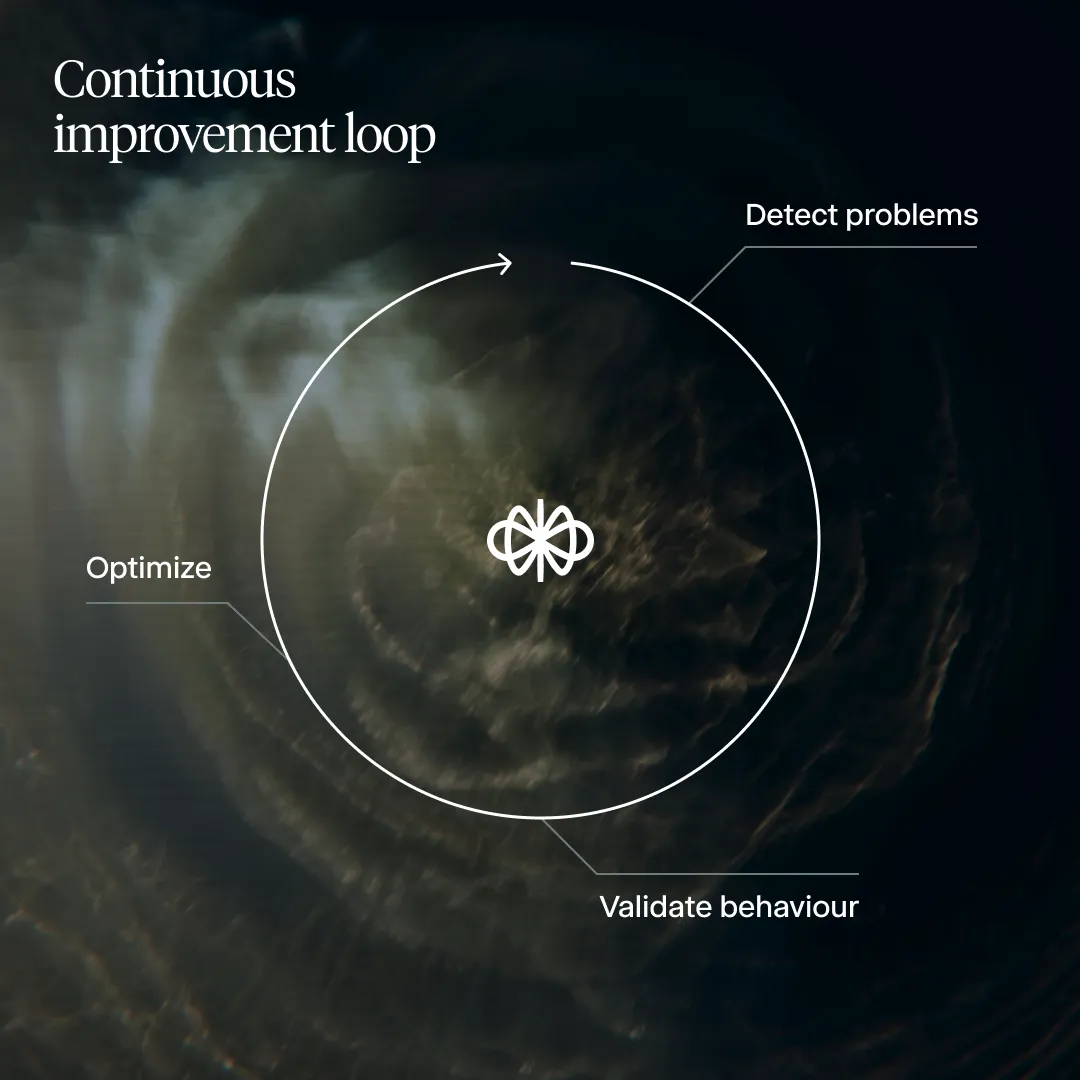
Teams observe how their agents behave in real interactions. Those insights inform adjustments to prompts, workflows, knowledge sources, or integrations. As agents improve, organizations gain greater confidence in their systems and expand automation to new use cases.
In this way, observability transforms AI agents from static deployments into systems that continuously evolve alongside the needs of the business and its customers.
As AI agents become more capable, they are also becoming more autonomous.
Organizations are increasingly relying on agents to handle complex interactions, guide customers through multi-step workflows, and support critical moments in the customer journey.
That shift raises the stakes.
Systems that directly represent a company’s brand and customer relationships cannot operate as black boxes. Enterprises need to understand how those systems behave, how they evolve over time, and how they influence the experience customers receive.
Observability provides the infrastructure for that understanding.
The next generation of AI-powered customer experience will not be defined solely by smarter models or more capable agents.
It will be defined by the systems organizations use to operate those agents responsibly.
Enterprises that build observability into their AI infrastructure will be able to deploy agents confidently, iterate quickly, and scale automation across their customer experience.
Those that cannot observe their systems will struggle to move beyond experimentation.
In other words, the future of agentic CX is not just about building AI agents.
It’s about building systems organizations can trust.
Observability gives teams the visibility they need to build, improve, and scale AI agents with confidence.
If you're exploring how to bring observability into your AI customer experience strategy, request a demo to see how Voiceflow helps teams monitor, evaluate, and continuously improve their agents.


.avif)
.avif)