

When Grok launched inside X in late 2023, it read like a side project: a chatbot with a sense of humor and live access to your timeline. Two years later it's a full model family, and xAI ships frontier-class releases on a cadence that rivals OpenAI and Anthropic.
Elon Musk still calls Grok the "ultimate AI assistant, capable of transforming how we interact with technology." This guide cuts past the framing and looks at what Grok actually is in 2026: the model lineup, what it does well, how it stacks up against ChatGPT and the rest, and what it takes to use a model like Grok in a real product.
What Is Grok?
Grok is the conversational AI assistant built by xAI, Elon Musk's AI company. It started as an X-only feature and now runs as a standalone product across web and mobile, on top of xAI's own family of large language models.
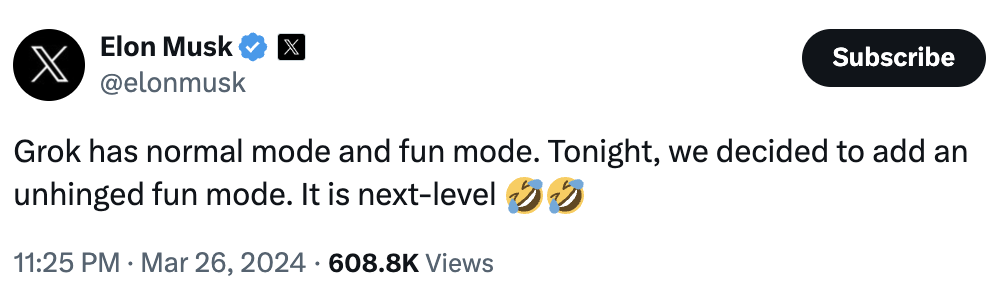
Its original hook still holds up: real-time access to public posts on X. Most assistants answer from a training snapshot, so they go stale between updates. Grok can pull what's happening on X right now, which makes it genuinely useful for breaking news, live events, and "what are people saying about X" questions. It also kept the personality xAI leaned on early, including a looser "Fun Mode" that other assistants tend to sand off.
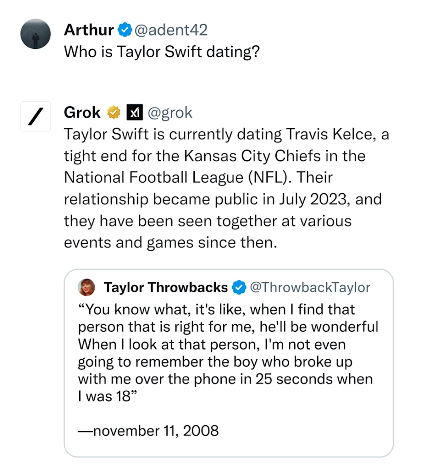
Grok's answer to "Who is Taylor Swift dating?"
The Grok Model Lineup: 2024 to 2026
The version you used in 2024 is not the Grok people mean today. The line moved fast, and each release closed a real gap:
- Grok-1 (open-sourced March 2024): the first public release, text-only.
- Grok-1.5 and 1.5V (2024): longer context and the first vision support.
- Grok-2 (August 2024): a sharper general model that added image generation.
- Grok-3 (February 2025): xAI's first serious reasoning model, with a "Think" mode and DeepSearch for live, cited web answers.
- Grok-4 (July 2025): the current flagship, a reasoning-first model, with a multi-agent "Grok 4 Heavy" tier for the hardest problems.
The short version: Grok went from a witty X add-on to a reasoning model that competes at the top of the benchmarks. If you tried it in 2024 and wrote it off, the 2026 version is a different tool.
What Grok Does Well
A few things genuinely set Grok apart, and a few are table stakes now.
Real-time information from X. This is still the clearest differentiator. Grok reads live public posts, so it's strong on current events and fast-moving topics where a static model guesses or hedges.
Reasoning and live search. From Grok-3 onward, the model can spend more compute "thinking" through a hard problem, and DeepSearch pulls and cites sources instead of answering from memory alone. That's the same direction every frontier lab is moving.
Multimodal input and output. Grok handles text and images, both reading them and generating them. The "first multimodal model" claim from the early days is no longer special, but the capability is solid and built in.
Personality. Grok's looser, more opinionated default tone is a real product choice. Whether that's a feature or a liability depends entirely on what you're building.
Grok vs. ChatGPT and the Rest
The honest 2026 answer: at the frontier, Grok, ChatGPT, Claude, and Gemini trade benchmark wins month to month, and the gaps are narrow enough that workflow fit matters more than a leaderboard.
Where each tends to pull ahead:
- Grok 4 leads on live information (its X access is unmatched) and holds its own on reasoning and math. Its personality is the most distinctive.
- ChatGPT is the broad all-rounder with the deepest ecosystem and tooling. See our look at GPT-5 and what's expected in GPT-6.
- Claude (Anthropic) is the common pick for coding and long, careful reasoning. We go deeper on Claude separately.
- Gemini is strongest when you live in Google's tools, as we cover in Gemini vs. Google Assistant.
- Open-weight models like Mistral and DeepSeek win when you need to self-host or control cost.
The reasoning push that started with OpenAI's o1 now runs across all of them, including Grok. If you want the broader field, our roundup of the best AI chatbots compares them side by side. The practical takeaway: don't marry one model. Pick per task, and keep the option to switch.
How to Access Grok
You have three ways in, depending on who you are.
As an X user. Grok is available to everyone on X, free with usage limits. Heavier use and the newest models come with X Premium+ or xAI's SuperGrok subscription.
As a standalone user. Grok runs on its own at grok.com and through dedicated iOS and Android apps, so you don't need an X account to try it.
As a builder. xAI ships a developer API. Create a key in the xAI console, point your code at the current Grok models, and you're calling Grok the same way you'd call OpenAI or Anthropic. Pricing and model availability shift often, so check x.ai for the current tiers before you commit.

Using a Model Like Grok in Production
Here's the part most "what is Grok" guides skip. Picking a model is the easy 10%. Turning it into an agent that reliably does a job, on your data, with guardrails you can trust, is the other 90%. The model is one swappable component. The platform around it is what ships.
That's the layer Voiceflow handles. It's model-agnostic by design: you build on leading models from OpenAI, Anthropic, and Google, and you can bring others (including Grok) through an API call, then switch as price and quality move. You're never locked to one lab's roadmap.
On top of the model, you get the parts that make an agent production-ready:
- Workflows and Playbooks. Workflows are deterministic paths for steps that must go right every time. Playbooks give the agent a goal and room to reason. They compose, so one agent moves between strict process and open judgment in a single conversation.
- Knowledge Base. Ground answers in your own content so the agent stays accurate instead of improvising.
- Observability, Evaluations, and Environments. See every conversation and why the agent did what it did, score interactions against your own definition of good, and test changes in staging before they reach customers.
- Security. SOC 2 Type 2 with PII masking built in.
A model like Grok can be a great engine. Voiceflow is the car you build around it.
![Help Desk Automation: What to Automate and How to Measure It [2026]](/images/help-desk-automation-og.jpg)