



![Ultimate AI: What It Is and Best Alternatives [2026]](/images/ultimate-ai-7c19fc9b-hero.webp)
If you are researching Ultimate AI in 2026, the first thing to know is that it no longer exists as a standalone product. In March 2024, Zendesk acquired Ultimate, and the platform now ships as Zendesk AI Agents. So a fair evaluation of "Ultimate AI" is really an evaluation of Zendesk's AI agent offering, plus a look at the AI customer service agents you would weigh against it.
This article covers what Ultimate AI was, what happened after the acquisition, how its pricing works now, and the alternatives worth comparing before you commit to the Zendesk ecosystem.
What Is Ultimate AI?
Ultimate AI is a customer support automation platform, now sold as Zendesk AI Agents, that resolves support requests across chat, messaging, and email. It was built to handle repetitive, high-volume tickets so human agents could focus on the complex cases.
The platform builds AI agents that understand a customer's request, pull an answer from connected knowledge sources, and either resolve the ticket or hand it to a person. It integrates with help desks and CRMs (Zendesk, Salesforce, Freshworks) to read context, trigger workflows, and sync customer data. Ultimate claimed its agents could resolve up to 80% of common requests, the kind of ticket deflection most support teams are chasing.
What Happened After Zendesk Acquired Ultimate?
This is the part most write-ups still miss. Zendesk announced the Ultimate acquisition on March 13, 2024, and folded the technology into its own platform. Ultimate's standalone product and brand have wound down; the capability now lives inside Zendesk AI Agents.
For buyers, that changes the evaluation in three ways:
- It is no longer a neutral, best-of-breed layer. Ultimate used to sit on top of whatever help desk you ran. Inside Zendesk, the deepest functionality assumes you are a Zendesk customer.
- The roadmap follows Zendesk's priorities. Independent startups move fast on their own bets. Acquired products move on the parent company's schedule.
- Pricing moved to Zendesk's model. The old Ultimate contract structure is gone (more on that below).
If that direction works for your stack, the integration is genuinely tight. If you would rather not tie your support automation to one help-desk vendor, that is the central reason to look at alternatives. We have written about the same dynamic with LivePerson and Cognigy, two other conversational platforms that landed inside larger companies.
Compare against an enterprise AI customer support platform.
What Are Ultimate AI's Core Features?
As Zendesk AI Agents, the core capabilities are:
- AI agents across chat, messaging, and email. They resolve common requests end to end and escalate the rest.
- CRM and help-desk integration. Tightest with Zendesk; connectors exist for Salesforce and Freshworks to manage tickets and sync data.
- Multilingual support. Coverage across 20-plus languages for global support teams.
- Analytics and reporting. Visibility into resolution rates, deflection, and agent performance.
- No-code building. Support teams can design and deploy agents without engineering, which lowers the barrier for CX teams.
These are solid table stakes for support automation. The gaps show up around channel breadth (no native voice), model choice, and how much of the value is locked to Zendesk.
Who Founded Ultimate AI?
Ultimate was co-founded in 2016 by Reetu Kainulainen, Jaakko Pasanen, and Markus Rautio. The three met at Tampere University in Finland and first worked together on a food-delivery startup before turning to customer-service automation. The company built its reputation in Europe before the Zendesk acquisition brought it into a global support platform.
Ultimate AI Funding and Acquisition
- Seed (2018): $1.3 million, co-led by Holtzbrinck Ventures and Maki.vc.
- Series A (2020): $20 million, led by OMERS Ventures, with Felicis Ventures, HV Capital, and Maki.vc participating.
- Acquired by Zendesk (March 2024): Zendesk bought Ultimate to build out its AI agent platform. This is the milestone that matters most today, because it is why "Ultimate AI" and "Zendesk AI Agents" now point to the same product.
How Much Does Ultimate AI Cost in 2026?
Standalone Ultimate pricing is no longer published. Before the acquisition, third-party buyer data put the average annual cost around $47,000, with larger contracts reaching $200,000, all on custom enterprise quotes.
Today the cost is whatever Zendesk charges for AI Agents, which sits on top of a Zendesk Suite subscription and increasingly uses outcome-based pricing (you pay per automated resolution rather than a flat seat fee). That means your real cost depends on ticket volume and how many requests the agent resolves, not a single list price. We break the tiers down in our Zendesk pricing guide. The practical takeaway: budget for the Zendesk Suite plus a usage component, and model it against your monthly ticket volume before signing.
Ultimate AI Alternatives Compared
Because Ultimate is now part of Zendesk, the right shortlist is other AI agent platforms you can run without committing to one help desk. Here is how the strongest alternatives compare.
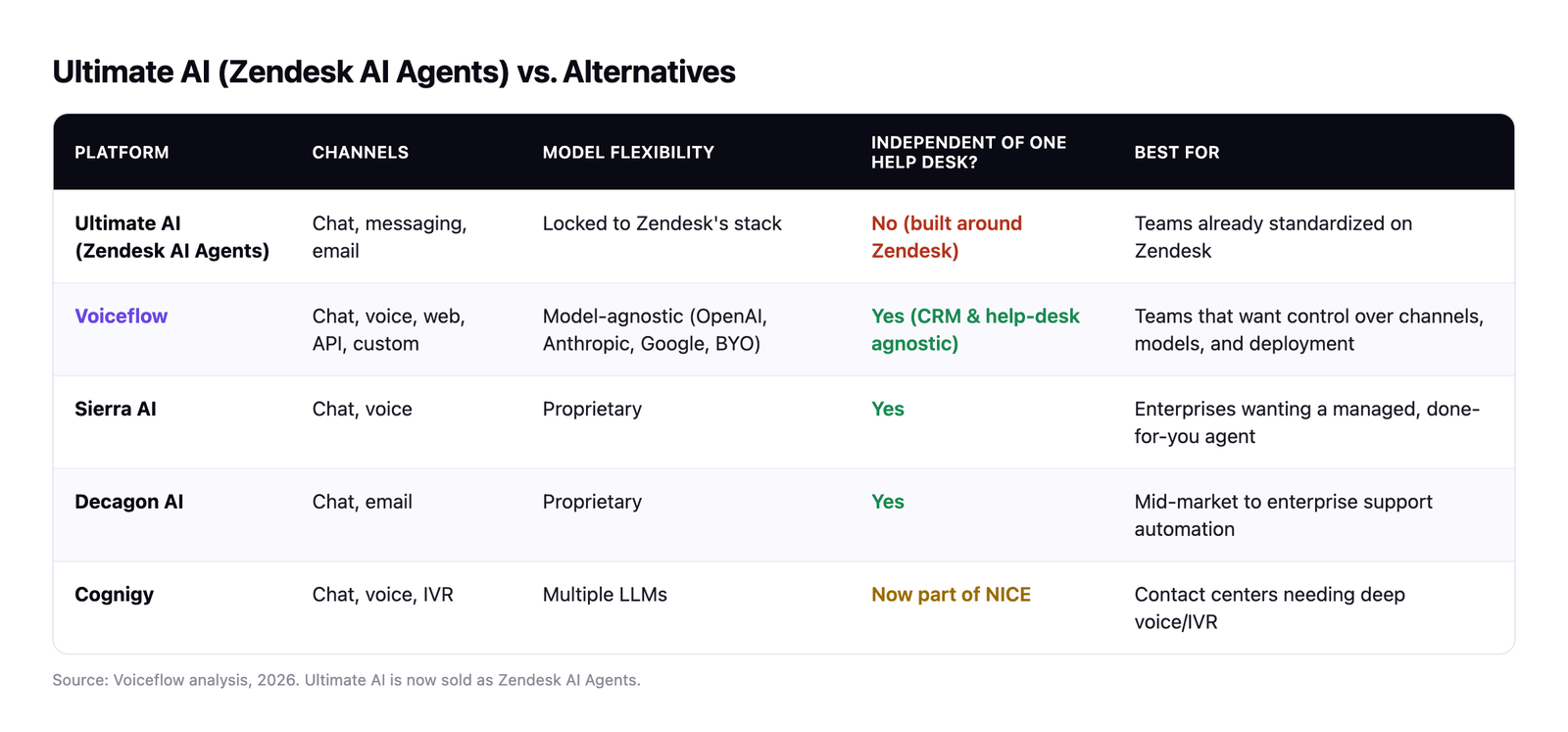
For a wider field beyond CX-specific tools, see our roundups of the best AI chatbots and the best AI chatbots for Zendesk, plus our comparison of agent management platforms. Two other vendor-eval write-ups worth reading are Sierra AI and Decagon AI.
Ultimate AI's Best Alternative: Voiceflow
If the thing that gives you pause about Ultimate is being locked into Zendesk, Voiceflow is the most direct answer. It is a platform for building, launching, and scaling AI agents that stays independent of any single help desk or CRM. Here is where it pulls ahead.
1. Model-agnostic, not locked in. Choose your LLM (OpenAI, Anthropic, Google) or bring your own. You are not tied to whatever model your help-desk vendor ships, which matters for both cost and quality as models change.
2. Voice as a first-class channel. Ultimate (as Zendesk AI Agents) covers chat, messaging, and email. Voiceflow adds native voice and phone alongside chat, web, and API, so one platform handles the contact center end to end.
3. A real Knowledge Base. Upload documents, URLs, or pasted content and the agent answers from them with retrieval-grounded responses, so you are not hard-coding every reply.
4. Built for production, not just launch. Evaluations let you test agents at scale before shipping, Observability gives conversation-level visibility for debugging, and Environments keep dev, staging, and production separate. This is what moves a pilot to a reliable deployment.
Voiceflow's independence is the difference that compounds over time: it adapts to your stack instead of forcing you into one vendor's ecosystem. If you are comparing AI agent platforms for customer service automation, that is the trade-off to weigh.
The Bottom Line
Ultimate AI proved that AI agents can resolve the majority of routine support tickets. That bet paid off, which is why Zendesk bought it. But "Ultimate AI" in 2026 means Zendesk AI Agents, with all the upside and the lock-in that comes with a single-vendor platform. If you are already all-in on Zendesk, it fits. If you want control over your channels, your models, and where your agents run, evaluate an independent platform before you sign.
![Intercom Pricing: The Ultimate Guide [2026]](/images/intercom-pricing-e81896ec-og.jpg)
![DeepAI: What It Is and Best Alternative [2026]](/images/deepai-e928e7fa-og.jpg)