



![AgentGPT: What It Is and Best Alternative [2026 Review]](/images/6a43cdf884b9f5c287faa30c_6a43cdf75445be6f668e4ab6_agentgpt-hero.webp)
Search for "agent gpt" in 2026 and you'll see two very different products in the top results. One is OpenAI's ChatGPT Agent, a hosted feature inside ChatGPT subscriptions that launched in July 2025. The other is reworkd's AgentGPT, the open-source autonomous agent project from 2023 that was archived on January 28, 2026. They share a name. They share almost nothing else.
This article covers both. It explains what's running on the live AgentGPT site today, and helps you decide what to use instead if you came here to build AI agents.
Are You Looking for ChatGPT Agent or AgentGPT?
These two products are confusingly similar in name and almost nothing else. Quick disambiguation:
- AgentGPT (the one this article was originally about) was an open-source autonomous agent project by reworkd, launched in 2023. The GitHub repo was archived on January 28, 2026. The hosted site at agentgpt.reworkd.ai still loads in a limited free state, but the project is no longer maintained.
- ChatGPT Agent is OpenAI's feature inside ChatGPT, released on July 17, 2025. It's available to Plus, Pro, Team, Enterprise, and Edu subscribers. It performs autonomous tasks (browsing, form-filling, multi-step research) using a built-in virtual browser, and OpenAI actively ships updates to it.
If you came here looking for an autonomous task agent and you're not a developer, ChatGPT Agent is the actively maintained option. If you're researching the historical AgentGPT project or comparing agent tools more broadly, the next sections cover what AgentGPT was and what to evaluate now. For a broader look at the AI chatbot landscape, we cover ChatGPT Agent and its competitors separately.
What Was AgentGPT?
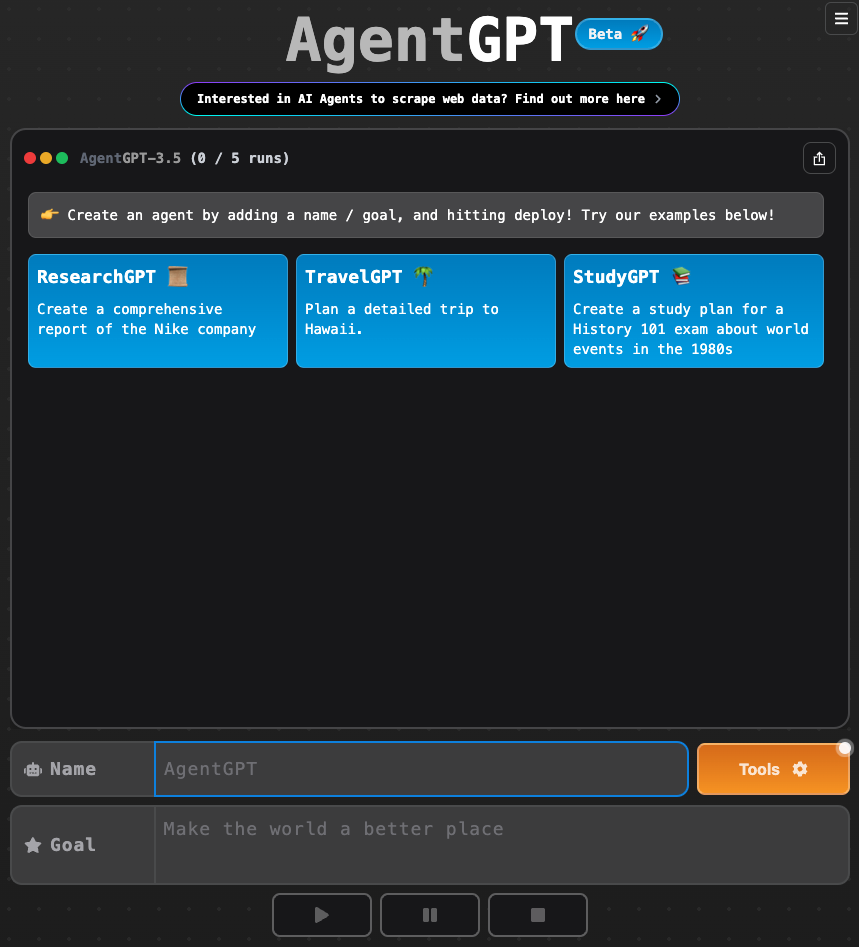
AgentGPT was an open-source AI platform that let users create and deploy autonomous agentic AI tasks in the browser. It used large language models, specifically OpenAI's GPT-3.5-Turbo (or GPT-4 in paid tiers). The agent took a user-defined goal, broke it into sub-tasks, and worked through them in order.
The platform ran on a simple premise: you typed a goal, AgentGPT decomposed it into smaller tasks, and the agent attempted each one in order. At its peak, the project had 36,000+ GitHub stars and was one of the most-cloned autonomous agent demos of the 2023 wave.
That wave didn't last. AgentGPT's last release was v1.0.0 in November 2023. The repository was archived by reworkd on January 28, 2026.
What the Archive Means for Current Users
The reworkd team made the GitHub repository read-only in January 2026. The hosted site at agentgpt.reworkd.ai still loads, but the practical implications are real:
No bug fixes, no security patches, no new model support. AgentGPT is frozen at its 2023 specifications. There's no path to GPT-5 era models, Claude, Gemini, or any newer LLM.
The free tier still works. At time of writing, the live site shows "AgentGPT-3.5 (0/5 runs)": five demo runs per day on the original model. Useful for a one-off test, not for ongoing work.
Paid tiers are effectively dormant. Pro and Enterprise pricing is still listed on the marketing site, but with the project archived, active billing and support are uncertain. Don't sign up for a paid plan unless you've confirmed it's still being processed.
Plan for the day the hosted site goes offline. Archived open-source projects often lose their hosting eventually. If your workflow depends on AgentGPT, treat it as borrowed time.
This pattern isn't unique. Other ambitious 2023-era autonomous agent projects (including Devin AI from Cognition Labs) have hit similar walls between demo-impressive and production-reliable.
What AgentGPT Could Do
In its active period, AgentGPT had three demo templates on its site:
- ResearchGPT: generate a research report on a topic (its canonical example was a Nike company profile).
- TravelGPT: build a detailed travel itinerary (the demo planned a trip to Hawaii).
- StudyGPT: produce a study plan (the demo built a History 101 plan for events in the 1980s).
Beyond the templates, the autonomous agent could handle:
- Research and synthesis: pull from web search results and produce a summary.
- Content drafting: blog posts, social media captions, short essays.
- Multi-step problem solving: break a complex goal into ordered sub-tasks.
- Task automation: chain together calls to external APIs (in the paid tiers).
- Ideation: brainstorm options for projects, campaigns, or product ideas.
Honest caveat: most of these worked well enough in demo conditions, less well at production scale. The cost-per-output ratio struggled once you moved past short tasks, and there was no monitoring or evaluation layer to catch agents that went off-track.
AgentGPT Pricing (Frozen at Archive)
The pricing tiers below reflect what AgentGPT offered when the project was still active. They're listed for historical reference; with the repo archived, treat anything beyond the free tier as uncertain.
How to Cancel AgentGPT and Request a Refund
The historical cancellation path was to email support@reworkd.ai. Reworkd is still an active company and has pivoted to other AI products since archiving AgentGPT. The email likely still reaches a real inbox, but response times for an archived product aren't guaranteed.
AgentGPT Pros and Cons in Retrospect
Looking back at what AgentGPT actually delivered:
Pros of AgentGPT
- API and third-party tool integration: paid tiers exposed integrations with external APIs, letting you chain agent actions across services.
- Accessible UI: the browser-based interface made autonomous-agent experimentation reachable for non-developers, years before ChatGPT Agent existed.
- Open source: anyone could clone the repo and run it locally. That's still true, even post-archive.
Cons of AgentGPT
- Model lock-in: OpenAI only. No path to Claude, Gemini, or any other provider.
- Demo-quality reliability: agents went off-track frequently on anything beyond simple research tasks.
- No production tooling: no observability, no evaluation framework, no environment separation between testing and live use.
- Cost-to-output ratio: scaling agent runs got expensive fast on the OpenAI API, especially on multi-loop tasks.
What to Use Instead of AgentGPT in 2026
If you came here trying to figure out what to use now, this is the section you actually want. Five honest options, depending on what you're trying to do:
- OpenAI's ChatGPT Agent: the closest spiritual successor for non-developers. Hosted inside ChatGPT Plus, Pro, Team, Enterprise, or Edu. Use it if you want autonomous task execution and don't need to deploy agents to your own customers.
- LangChain agent framework: code-first, modular, the dominant open-source library for building agentic workflows. Use if you're a developer building custom agent logic.
- AutoGen: Microsoft's multi-agent orchestration framework. Good fit for complex multi-agent setups where agents collaborate or compete.
- CrewAI: a newer Python framework with simpler agent and task definitions than LangChain. Lower learning curve, smaller feature surface.
- Voiceflow: for production deployments where customers actually interact with the agent. The next section covers this in detail.
For a deeper comparison of the developer-framework options, our AI agent framework comparison post walks through the five most-used contenders.
Voiceflow: For Production-Ready Agent Builds
Voiceflow is built for teams who need to ship and operate AI agents, not just demo them. If "build something like AgentGPT, but real" is closer to your goal, here's what makes Voiceflow the production path:
- No-code agent builder: a drag-and-drop canvas where designers, conversation designers, and engineers work in the same file. More on what an effective AI agent builder looks like.
- Model-agnostic: swap between OpenAI, Anthropic, Google, or bring your own model. AgentGPT was OpenAI-only. ChatGPT Agent is OpenAI-only. Voiceflow lets you pick what fits the task and switch as the model landscape shifts.
- Knowledge Base (RAG): ground agents in your own documents, not just public web search. This is what makes agents useful for support, sales, and internal use cases where accuracy matters.
- Voice channel: agents can run on phone, IVR, and voice bots. AgentGPT was browser-only. ChatGPT Agent doesn't deploy to phones either. If your customers call you, this is the path.
- Observability and Evaluations: monitor agents in production, run regression tests before shipping changes. This is the gap that killed AgentGPT for serious teams.
- Real deployment customers: Turo, StubHub International, Sanlam Studios, and Trilogy use Voiceflow to run production conversational AI agents, not browser demos.
Ready to Build a Production-Grade AI Agent?
If your reason for searching "agent gpt" was "I want to build something like this for my team or my customers," AgentGPT isn't the answer in 2026. The archive made sure of that. Voiceflow is the production path. Visit the AI agent builder overview to see what it looks like, or book a demo and we'll walk through your specific use case.
For browser-native automation agents, see our Bardeen AI review.
![Is Kore.ai Right For Your Business? [Review 2026]](/images/kore-ai-879e26dc-og.jpg)