



Call center compliance means meeting every regulation that governs how your center records calls, markets to consumers, handles payment and health data, and protects personal information, from the Telephone Consumer Protection Act and the Telemarketing Sales Rule to PCI DSS, HIPAA, GDPR, and CCPA/CPRA. On a floor staffed entirely by people, you meet that bar with training, scripts, and QA sampling of a small slice of recorded calls. On a floor where an AI agent is answering part of the volume, that model breaks down fast. The only controls that hold up at AI call volume are the ones built into the agent's workflow and visible in a full execution trace, not the ones the agent is trusted to remember.
This is not legal advice. Treat it as an engineering starting point and confirm the specifics for your jurisdictions with counsel.
The Regulations Every Call Center Has to Meet
Six regulatory regimes show up in almost every call center compliance review, and each one maps to a specific control you will need to wire into your agent's workflow later in this guide.
If you are comparing platforms for a floor where AI is taking live calls, the architecture choices covered in AI call center platforms determine how much of this table you can enforce structurally versus how much you are left policing by hand.
Call Recording Consent: One-Party vs. All-Party Rules
Recording consent splits into two models depending on jurisdiction. One-party consent means any party on the call, including your own agent or AI system, can authorize the recording. All-party consent, sometimes called two-party consent, requires every participant to agree before recording starts.
Treat your consent requirement as the strictest jurisdiction any caller could be in, not the state your call center sits in. A caller in an all-party state recorded under a one-party assumption is a violation regardless of where your infrastructure lives.
The practical fix is a forced disclosure step at the start of every call, something like "This call may be recorded for quality and training purposes," delivered before any other interaction happens. That only works as a control if the step cannot be skipped, reordered, or talked past, which is the same requirement you will see again in the AI section below.
Protecting Payment and Health Data on the Call
PCI DSS does not allow sensitive authentication data, including the CVV, to be stored anywhere in your systems, even encrypted. HIPAA requires that protected health information only be accessed and retained by the people and systems that actually need it for the task at hand.
Both rules point to the same engineering pattern: certain data types must never reach storage, logs, or a model's context window, no matter how the call unfolds.
This is a redaction problem, not a training problem. An agent instructed "don't write down the CVV" is one prompt change away from writing down the CVV. PII redaction applied at the pipeline level, before the data touches a transcript or a model, removes the dependency on the agent getting it right every time.
Building the Compliance Program: Owners, Controls, Review Cycles
A control without an owner decays the same way an untrained habit does. Each regulation above needs a named person accountable for it, a defined control that enforces it, and a cadence for checking the control still works.
Training and QA monitoring still matter here, but their job changes once controls are embedded: QA is no longer the primary catch mechanism for a missed disclosure or an unmasked card number, it is the check that confirms the embedded controls are still firing as designed.
What Changes When an AI Agent Takes the Call
Everything above assumes a human who can be coached, corrected, and spot-checked. An AI agent is not coached, it is configured, and that distinction is where most compliance programs built for human floors fall apart.
A model instructed to "always get consent before recording" can still skip it under the right prompt or edge case, and a small QA sample will not catch that before a regulator does. The fix is to stop treating compliance as something the agent remembers and start treating it as a property of the workflow itself.
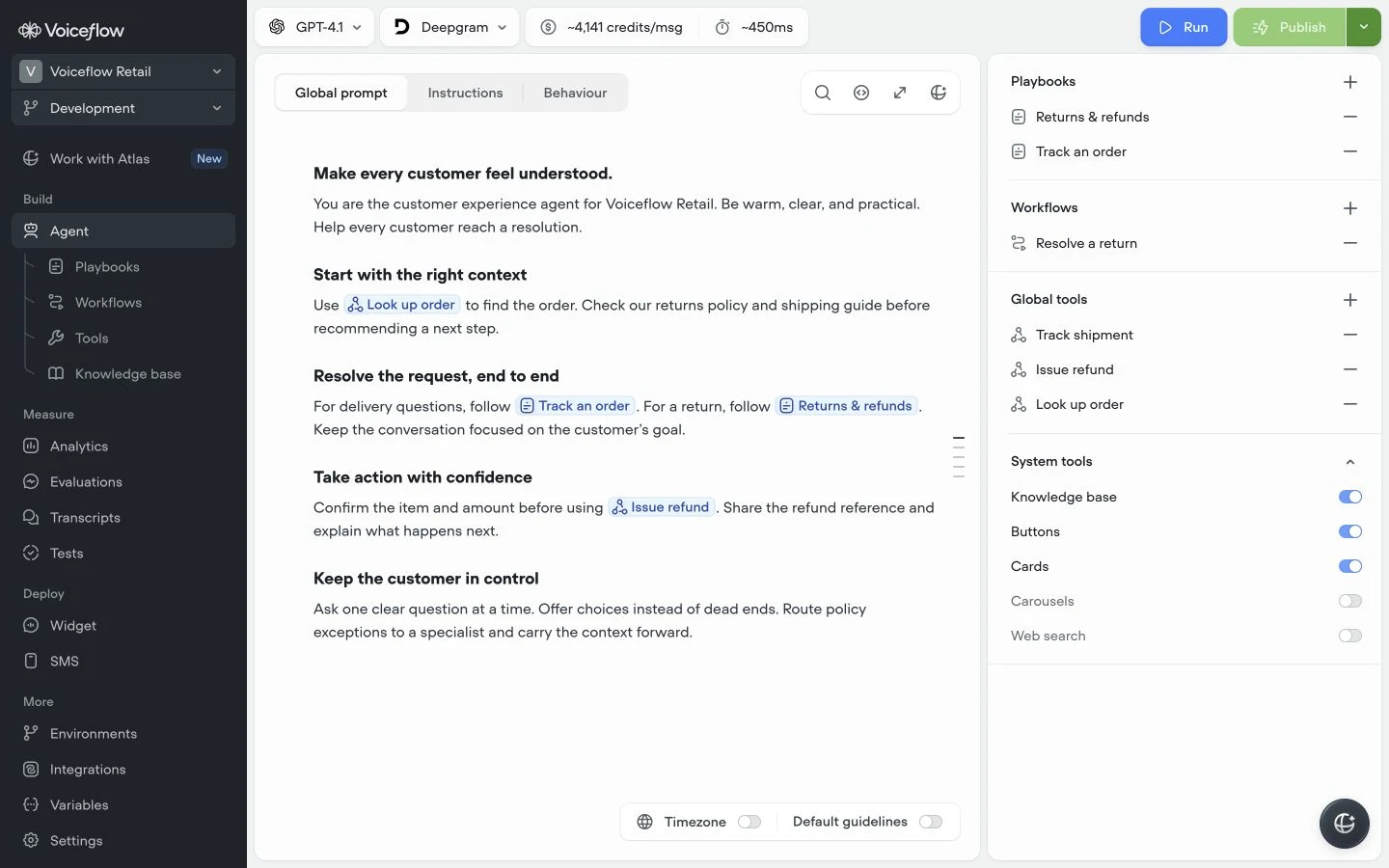
Four mechanisms do the actual work here. Scoped permissions limit what the agent can retrieve or act on, so a payment or health question it is not cleared to handle is structurally out of reach rather than a matter of self-restraint. Deterministic steps for disclosure and consent run as required nodes in the workflow, not as instructions the model is expected to recall under pressure. Full execution tracing logs every decision and API call the agent makes during a conversation, which is what turns "we believe the agent is compliant" into something you can actually produce in an audit. And a clean handoff step or call forward step routes regulated actions, like processing a refund or discussing a diagnosis, to a human agent with full context instead of letting the AI attempt them unsupervised.
That combination is also what AI agent security and compliance programs are built around more broadly, and it applies just as directly to an AI IVR handling inbound volume as it does to outbound calling. On the infrastructure side, a platform's own SOC 2 Type II, ISO 27001, GDPR, and HIPAA support covers the hosting and data-handling layer, but it does not replace the workflow-level controls above. Those still have to be designed into each agent you deploy. A full conversation history with every execution trace attached is what your audit team should expect to pull, not a transcript sample and a training deck.
The Call Center Compliance Checklist
Use this as a starting point, not a complete audit. Add rows for anything specific to your industry or jurisdiction.
- Regulation coverage: TCPA, TSR/DNC, PCI DSS, HIPAA, GDPR, and CCPA/CPRA mapped to which call types each one touches
- Consent: recording disclosure built as a required step, set to the strictest applicable jurisdiction
- Payment data: CVV and full card numbers excluded from transcripts, logs, and model context
- Health data: PHI access scoped to minimum necessary, masked in general-purpose logs
- Program ownership: a named owner and review cadence for every control above
- AI-specific controls: scoped permissions, deterministic disclosure and consent steps, full execution tracing, and a defined handoff path for regulated actions
- Audit readiness: the ability to produce a complete trace for any AI-handled call, not just a transcript
Run your current AI agent workflows against this list before your next audit cycle, not after. If the gaps are mostly in the last two rows, call center solutions built around workflow-level permissions and tracing are worth evaluating before you expand the volume you are routing to AI.