



A warm transfer happens when the agent holding a conversation puts the customer on hold, briefs the next agent on the situation, then connects the two so the customer doesn't have to explain themselves twice. A cold transfer skips that briefing step: the conversation routes to a new agent who picks it up blind. For years this was a style question: warm feels more polished, cold is faster. Now that AI agents handle the first leg of most support conversations, it's not a style question anymore. It's a line item. Every context-free handoff from an AI agent to a human manufactures a second interaction. The human has to re-diagnose what the AI already knew, the customer repeats the problem, and your repeat-contact rate climbs. Treat the warm transfer as a design decision tied to cost per contact, not an etiquette rule you hope agents remember.
What a Warm Transfer Is (and How It Differs From a Cold Transfer)
A warm transfer, also called an attended or consultative transfer, is the version where the first agent briefs the next one before connecting the customer. The first agent puts the customer on hold, reaches the receiving agent, and explains who the customer is and what they need. Only then do they connect the call or chat.
A cold transfer is the same routing action without the briefing. The conversation moves, but nothing travels with it except maybe a queue tag. The receiving agent opens the ticket or picks up the call and starts from zero, which means the customer starts from zero too.
Neither is inherently better. The difference is whether context survives the handoff, and whether that context was worth preserving in the first place.
How a Warm Transfer Works, Step by Step
In a traditional, human-to-human warm transfer, five things happen in order:
- The first agent recognizes the issue needs a different team or skill set.
- They place the customer on hold, or mute, on chat.
- They contact the receiving agent directly and summarize the situation: who the customer is, what they've already tried, what they need.
- The receiving agent confirms they're ready to take over.
- The first agent reconnects the customer and introduces the handoff before dropping off.
That sequence assumes two humans and a phone line. It breaks down a little when the first "agent" is an AI handling chat, voice, or SMS. There's no hold music, no verbal briefing, and no moment where one person tells another person what's going on. Something still has to do the job that step 3 does: carry the context forward. How that happens for an AI-to-human handoff is the part legacy telephony guides don't cover, and it's where the next sections go.
Warm Transfer vs. Cold Transfer
Use this as a starting checklist, not a rulebook. The table tells you what each transfer type costs and protects. The next section tells you when that tradeoff is worth making.
When to Use a Warm Transfer, and When Cold Is Fine
Reach for a warm transfer when the cost of losing context is higher than the cost of the delay. That's three situations:
- Upset customers who've already explained themselves once and don't want to again.
- Complex or sensitive issues, like billing disputes or account security.
- Specialist escalations where the receiving agent needs background just to start, like a technical issue that's already been through two rounds of troubleshooting.
Cold transfer is fine when there's genuinely no context to lose. That covers simple routing, like sending a customer from a general queue to the billing team before any troubleshooting has happened. It also covers high call volumes where speed matters more than continuity, and the receiving team's first move is always the same regardless of history.
What to say matters more than people think, on both ends of the transfer. To the customer, keep it brief: "I'm connecting you with our billing specialist. I've already explained your situation, so you won't need to repeat it." To the receiving agent, give them the shape of the problem, not a transcript. Name the issue, what's already been tried, and what outcome the customer wants. A receiving agent who gets three clear sentences performs better than one who gets a forwarded wall of text.
How AI Agents Do a Warm Transfer to a Human
This is where the human-to-human playbook stops being enough, and where most guidance on human-agent handoff still falls short. When an AI agent hands off a conversation, "briefing the receiving agent" has to be something the system does automatically. It can't depend on an agent choosing to do it well.
A warm handoff from an AI agent needs four things:
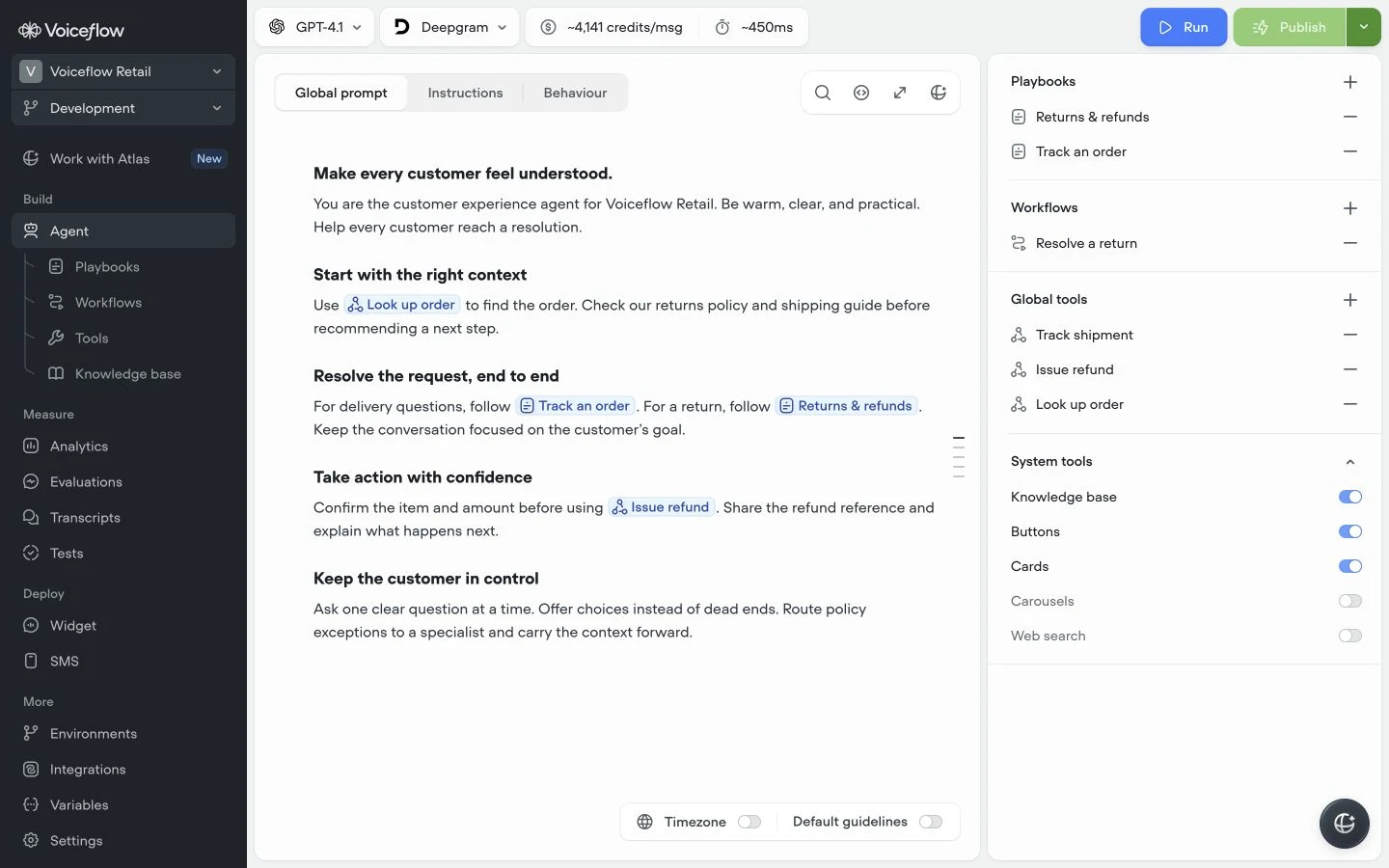
- Context passed as data, not just text. The receiving agent needs the full conversation history plus structured variables: an AI-generated summary, an order ID, a routing reason, whatever the team decided matters. Voiceflow's Handoff step passes the full transcript along with whichever variables the team chooses. The receiving agent opens the case already knowing what the AI knew.
- Routing to a real platform, not a queue and a prayer. The handoff needs to land in a system the human agent already works in. Voiceflow connects to Genesys, Ujet, Kustomer, Dixa, and Zendesk, with more providers available on request. Once the human picks it up, it keeps relaying messages and files in both directions.
- A fail path for when the handoff can't start. Agents go offline, queues fill up, integrations hiccup. When that happens, a warm transfer with no fallback turns into a cold transfer by accident, or worse, a dropped conversation. Voiceflow's handoff step follows a defined fail path when it can't connect, instead of leaving the customer stranded.
- A way back to the AI. Not every handoff should end in a human resolving the whole thing. Once the human agent has done their part, the conversation can return to the AI agent to close out. That keeps the human's time reserved for the part that actually needed them.
On voice specifically, the mechanics differ again. A live call transfers through the Call forward step, which moves the call to a phone number or SIP address and passes CallerID through. The exception is Vonage numbers, where that passthrough isn't available. The context problem doesn't go away on voice, it just travels differently: through connected systems and summaries rather than through the call itself.
"You should be impressed by how little you need to use our Human-Agent Handoff feature, because our AI is built to resolve as much as possible, as accurately as possible." Mike Hood, Head of Product at Voiceflow
The warm transfer, done right, happens on the small share of conversations that actually need a human. The AI should have already done the diagnosis. The human's job is to finish it, not start over.
What to Measure After the Handoff
A warm transfer is a hypothesis: that passing context prevents a second interaction. Whether it's working is measurable, and three numbers tell you.
Repeat-contact rate. Did the customer have to reach out again, or re-explain, after the transfer? A rising repeat-contact rate on transferred conversations is the clearest sign that context isn't reaching the human agent, whatever your handoff design claims to do.
Transfer time. How long between the AI recognizing it needs to escalate and the human agent actually engaging? A warm transfer that adds meaningful delay is trading cost in one place (agent re-diagnosis) for cost in another (customer wait). Track it, don't assume it.
Handle time after transfer. If the human agent's handle time on transferred conversations looks the same as a cold start, the context isn't doing its job. A working warm transfer should show a measurably shorter handle time than a comparable conversation with no context passed. That's because the agent isn't re-asking questions the AI already answered.
Pull these from your transcripts and analytics rather than guessing from agent feedback. Agents will tell you the handoff "feels fine" long before the numbers confirm it. If you're setting this up for the first time, start with the setup guide for live agent handoff. Work backward from what you want those three numbers to say in a month.