



Most ecommerce chatbots people remember were bad. A pop-up that asked "How can I help?" and then misunderstood every question you typed. That version deserved the eye-rolls it got.
The 2026 version is a different product. It reads what a shopper actually wants, pulls a real answer from your catalog and policies, and takes action like tracking an order or starting a return. The hard part isn't the chat window. It's picking the right tool and setting it up so it helps customers instead of frustrating them.
This guide covers what an ecommerce chatbot does today, how to evaluate one, the tools worth shortlisting, and how to build your own when an off-the-shelf bot won't fit.
What an Ecommerce Chatbot Actually Does in 2026
An ecommerce chatbot is an AI agent that handles shopper conversations on your store, by chat or voice. The useful ones earn their place on a few high-volume jobs:
- Support triage. Answering FAQs, checking order status, and handling routine "where is my order" questions before they reach a human. These repetitive tickets are the easiest wins, and they're the bulk of most customer service chatbot volume.
- Order tracking and returns. Looking up an order through your platform's API, reading the status back, and kicking off a return or exchange without a human touching it.
- Product discovery. Asking what a shopper needs and recommending products from your real catalog, which is where conversational AI for e-commerce tends to move revenue rather than just deflect tickets.
- Cart recovery. Catching a hesitating shopper with a relevant nudge or answering the one objection holding up the purchase.
- Post-purchase. Order confirmations, shipping updates, and reorder prompts over channels like a WhatsApp chatbot or the site widget.
What should stay with people: high-value disputes, anything emotional, and genuinely ambiguous requests. A good bot knows its limit and does a clean handoff to a human instead of trapping the shopper in a loop.
What to Look for in an Ecommerce Chatbot
This is where most buying decisions go wrong. The demo always looks great. Production is the real test. Five things decide whether a chatbot helps your store or quietly costs you sales.
Grounding in your real data. The bot has to answer from your live catalog, pricing, and policies, not a generic script. That means it retrieves from a knowledge base you control, so it stops inventing return windows that don't exist.
Platform fit. It should connect to your stack with real integrations, not a brittle workaround. If you're on Shopify, look for native support rather than a manual export. Voiceflow connects to Shopify, WooCommerce, and the rest, which is the difference between live order data and a static FAQ.
Clean handoff. When the bot hits its limit, it should pass the conversation to a person with the full context attached, not start over. Get this wrong and you undo every bit of goodwill the automation earned.
Honest measurement. Deflection rate on its own will lie to you. A "handled" chat that frustrated a shopper into leaving counts as a deflection and a lost sale. Watch real resolution and escalation instead, which is the case we make about what ticket deflection rate actually means.
Pricing you can predict. Many commerce bots charge per resolution. Intercom's Fin runs about $0.99 a resolution, and tools like Tidio and Gorgias price similar conversation tiers. That model is fine until volume spikes during a sale, when the bill scales with the traffic you wanted. Check how cost behaves at your busiest week, not your average one.
Best AI Chatbots for Ecommerce
There's no single best tool. There's the right fit for your store size, stack, and how much you want to build yourself. Here's an honest read on five common options, including ours.
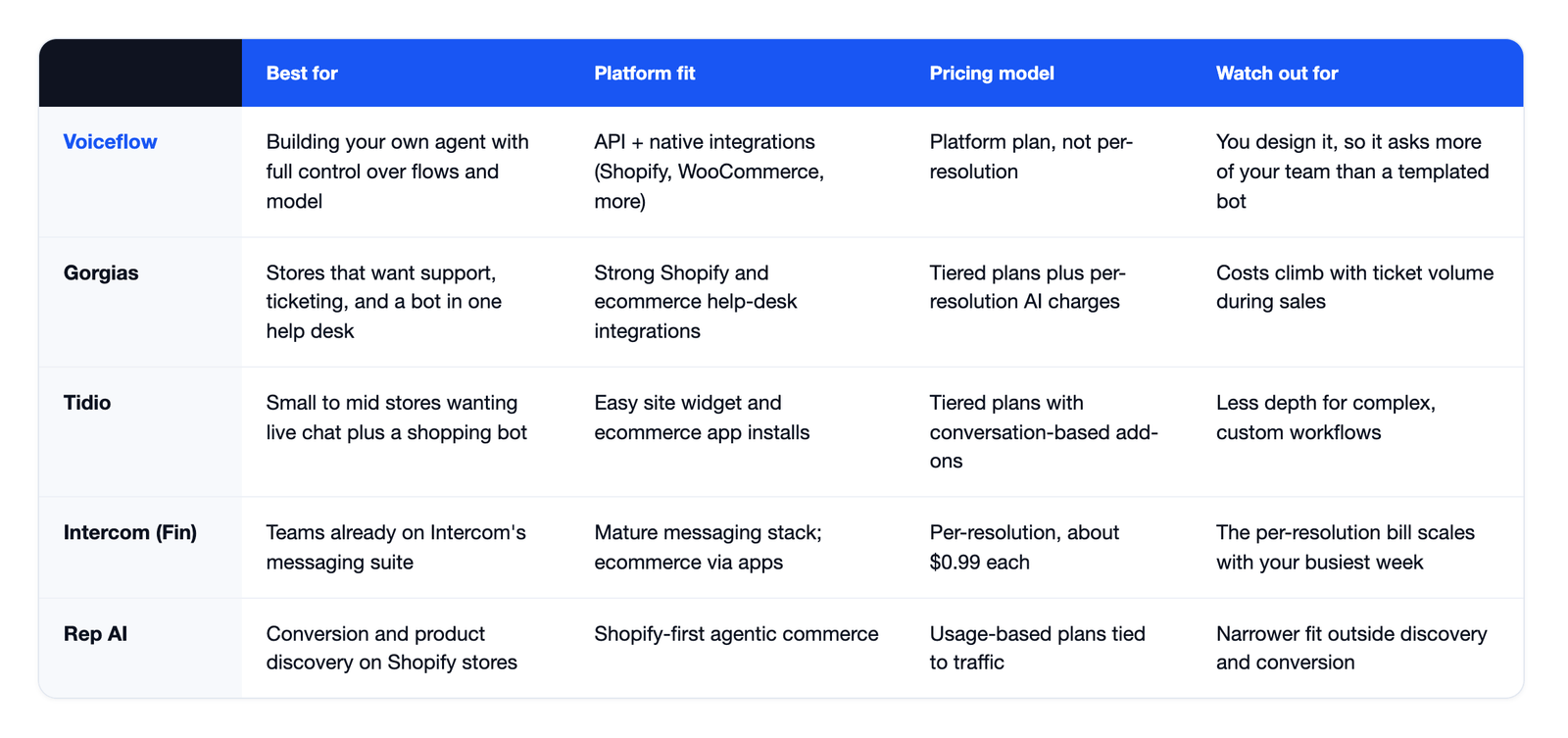
A quick translation. Gorgias and Tidio are CX help-desk platforms with shopping bots bolted on, strong if you want support and ticketing in one place. Intercom with Fin is a mature messaging suite, capable but priced per resolution. Rep AI leans into agentic commerce and conversion, a good fit if product discovery is your main goal. Voiceflow is the build-your-own option: you design the agent, choose the model, and ship it on your channels, which suits teams that have outgrown a templated bot. If you want a broader survey, our best AI chatbot roundup goes wider than ecommerce.
How to Build an Ecommerce Chatbot on Voiceflow
If an off-the-shelf bot won't fit, building your own is more achievable than it used to be. Skip any guide promising a production chatbot in two minutes. You can prototype one in an afternoon. Shipping one that handles real shoppers takes a few rounds of testing, and that's normal. Here's the shape of the build on Voiceflow, the platform I work on.
- Map the conversation. Use Workflows for the deterministic steps that must happen the same way every time, like verifying an order or processing a return. Use Playbooks for the open-ended turns, like product questions, where you give the agent a goal and let it reason.
- Connect your store. Wire the agent to your platform through the API so it pulls live product and order data. This is what turns a Shopify chatbot from a glorified FAQ into something that answers "where's my order" with a real tracking number.
- Ground it in a knowledge base. Upload your policies, sizing guides, and FAQs so the agent answers from your content instead of guessing.
- Pick your model. Voiceflow is model-agnostic, so you choose the LLM (OpenAI, Anthropic, Google) and swap it as cost and quality shift. You're not locked to one vendor's roadmap.
- Set the handoff rule. Decide what triggers a transfer to a person, and route the conversation with its history attached.
- Test, then watch it. Run Evaluations before launch, ship through separate dev and production Environments, and use Observability to see what the agent actually said to live shoppers. That last step is where the real tuning happens.
For stores handling order and payment data, Voiceflow runs with SOC 2 Type 2 compliance and PII masking. Teams like Turo, StubHub International, Sanlam Studios, and Trilogy build their agents this way rather than stitching the stack together from scratch.
Best Practices for Ecommerce Chatbots
A few habits separate the bots shoppers tolerate from the ones they avoid.
- Lead with the high-volume jobs. Automate order tracking, FAQs, and returns first. These are the calls that eat a support team's day and the ones a bot handles cleanly.
- Personalize from real data, not guesses. Use order history and account context to tailor answers. A recommendation that ignores what someone already bought reads as noise.
- Meet shoppers on their channel. The site widget covers most traffic, but WhatsApp and messaging apps matter for post-purchase. Match the channel to where your customers already are.
- Give a visible exit to a human. A clear escalation path prevents the rage-quit. The goal is a smooth pass to an agent, not a dead end.
- Measure resolution, then iterate. Track whether shoppers actually got what they needed, and use that to tune the agent. This is the same loop behind any serious customer service automation program.
For more patterns across industries, our chatbot examples post has concrete builds, and the AI customer service agent guide goes deeper on the support side.
![How to Build an AI Customer Service Chatbot in 2026 [4 Steps]](/images/6a43ce001e6159bc6c9e7517_6a43cdff6f82bf70d1a9b668_customer-service-chatbot-hero.webp)